
European Economic
and Social Committee
Tackling the energy crisis: organised civil society calls for a realistic and pragmatic approach to energy transition
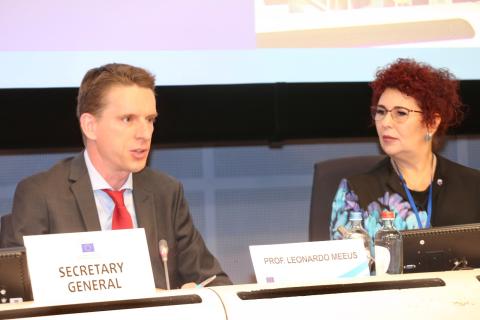
The European Economic and Social Committee (EESC) debated its strategic vision on energy, highlighting the actions needed to reform the EU's energy market. It also stressed the need to guarantee security of supply and affordable prices for both consumers and industry.
The EESC is committed and determined towards the decarbonisation of the EU's energy system, and calls on EU policy-makers to respond to the consequences of decades-long energy dependence.
EESC president Christa Schweng addressed the plenary session with these words on 26 October 2022 in the debate on the EU's energy transition and strategic autonomy, which featured Professor Leonardo Meeus from the European University Institute, Director of the Florence School of Regulation and Loyola de Palacio Chair in the Robert Schuman Centre.
We need to work on a green transition at a pace that businesses and societies are able to keep up with, and with accompanying measures allowing for Europe's global competitiveness and innovation. The EU has the potential to reduce its dependence on imported energy by developing its local, renewable energy capacity, but proper investment incentives need to be ensured,
said Ms Schweng.
Professor Meeus referred to the EU electricity market reforms proposed by the European Commission, pointing out that the current electricity market that had been built over the past 20 years could be part of our future, as long as we completed and combined it with new instruments to engage consumers and modernise networks.
The energy crisis would have been bigger if we had not had these electricity markets. When there are shortages in one Member State, the flows cross the border and reach another country, helping to build stability and solidarity in the European Union,
he said.
The debate took place in connection with the adoption of the opinion A strategic vision on energy transition to enable the EU's strategic autonomy drafted by Thomas Kattnig, Lutz Ribbe and Tomasz Andrzej Wróblewski.
The energy transition is the EESC's key political priority for 2022, and this own-initiative opinion is an "umbrella" opinion, bringing together the conclusions of seven other opinions prepared by the Committee's six sections and Consultative Commission on Industrial Change (CCMI).
The opinion sets out the EESC's vision on the energy transition and its role in achieving the EU's strategic autonomy, focussing on speeding up decarbonisation, reducing dependency on energy imports, increasing ownership of the energy transition by people and businesses and supporting vulnerable households.
During the debate, Mr Wróblewski stressed that the current energy crisis and lack of security, stability and predictability of supply would be less severe if more targeted measures had been adopted earlier and the European Energy Union had been taken more seriously, the objective being not to diversify dependencies but rather to ensure, as much as possible, strategic energy independence and autonomy.
Mr Ribbe stated that the Committee showed in its opinion which measures were needed in the energy sector in order to become more independent from energy imports and to achieve strategic autonomy, highlighting the important role that civil society could play in the energy transition.
Finally, Mr Kattnig said that the social dimension must be taken into account in the energy transition and that a "just transition" was not just a question of financing the transition, but also included the objective of safeguarding workers' rights, creating decent work, quality jobs, strengthening democratic participation and social security.
Work organisation
Downloads
-
Tackling the energy crisis: organised civil society calls for a realistic and pragmatic approach to energy transition
Recommended for you
Az egészségügyi ágazatbeli közszolgáltatások közös létrehozása erősíteni fogja a demokrácia részvételi jellegét az EU-ban
News
Az Európai Gazdasági és Szociális Bizottság (EGSZB) és a Debreceni Egyetem által szervezett rendezvény rávilágított, mennyire fontos az általános érdekű szolgáltatások közös létrehozása az…
YEYS! 2023: A fiatalok átláthatóbb, digitalizált és egyszerűbb EU-t szeretnének
News
Március 23-án és 24-én az Európai Gazdasági és Szociális Bizottság (EGSZB) immár 14. alkalommal adott otthont a „Your Europe, Your Say!” (A Te Európád, a Te szavad! – YEYS!) című rendezvénynek. Erre…
Az EGSZB megnyitja a jelentkezést civil társadalmi díjára, melynek témája a mentális egészség
News
Civil társadalmi szervezetek, magánszemélyek és magánvállalkozások mostantól nevezhetik nonprofit projektjeiket az európai polgárok mentális jólétének támogatásának szentelt EGSZB-díjra. Az Európai…
Az EGSZB felhívása: 2024 júniusában szavazzunk egy egységes és demokratikus Európai Unióra!
News
A demokrácia világszerte hanyatlik, a növekvő infláció és a háború fenyegető veszélye közepette a dezinformáció térnyerése és egyre nagyobb elégedetlenség tapasztalható. Nagy tehát a tétje az új…
Az Európai Gazdasági és Szociális Bizottság készen áll arra, hogy együttműködjön az EU Tanácsának magyar elnökségével
News
Az Európai Gazdasági és Szociális Bizottság (EGSZB) júliusi plenáris ülésén Oliver Röpke EGSZB-elnök vitát tartott Bóka János európai uniós ügyekért felelős miniszterrel, aki ismertette az EU Tanácsa…