International Trade

This page is also available in:

International trade is governed by a complex mixture of global rules agreed under World Trade Organization and bilateral and multilateral agreements. The free trade agreements are having a growing impact on citizens' rights. Under the Lisbon Treaty, EU trade policy must be conducted within the framework of the principles and objectives of the Union’s external action, including promotion of the rule of law, human rights and sustainable development.

We believe that this trend should be a guiding principle in EU trade negotiations and in trade relations. The fact that we at the EESC reconcile the positions and views of business, workers, professionals, farmers, consumers and other important stakeholders contributes real added value. We are in a position to efficiently relay the opinions of civil society and interest groups to international policy-makers both during negotiations and in the implementation of trade agreements. We have set up a Follow-up Committee on International trade to ensure that civil society has a say in the shaping of EU trade policy. We are also managing the Domestic Advisory groups set up under the trade and sustainable development chapters of the EU "new generation" trade agreements. These groups, composed of civil society representatives (from inside and outside the EESC) are responsible for identifying trade and sustainable development-related problems in the implementation of a trade agreement.

  • World trade, a new paradigm?

    In this issue:

    • Our members write about the future of world trade and EU trade policy
    • Guest articles by Agnès Mathis (Director of Cooperatives Europe), Sergey Lagodinsky (Member of the European Parliament) and Carmen Lică (Executive Director of Centrul Step by Step Romania)
    • Interview with co-rapporteur Louise Grabo on challenges and opportunities of Crypto Assets
    • Information about the conference 'Civil society organisations defending and strengthening European democracy' on 30 March 2023
    • Civil Society Organisations' Bulletin - March 2023
  • Le 8 mars 2023, la cinquième réunion du groupe consultatif interne de l'UE s'est tenue dans un format hybride. L'un des objectifs de la réunion était de préparer la partie européenne à la prochaine réunion conjointe avec le DAG de Singapour. Les membres ont suivi une présentation sur le commerce des services entre l'UE et Singapour, donnée par M. Pascal Kerneis, président du DAG de l'UE. En outre, les membres du DAG ont reçu des mises à jour de la DG COMMERCE de la Commission européenne sur les questions horizontales de commerce et d'investissement avec Singapour ainsi que sur la mise en œuvre du chapitre sur le commerce et le développement durable de l'accord de libre-échange UE-Singapour.

  • Published in
    16 pages

    Priorités du groupe des employeurs du CESE

  • 22nd meeting of the EU Advisory Group for the EU-Central America Association Agreement

  • 18th meeting of the EU - DAG Colombia-Peru-Ecuador

  • -

    8th joint meeting of the EU DAG and representatives from the domestic mechanisms of Colombia, Peru and Ecuador and Civil Society Open Session

    Workshop and D2D + Civil Society Forum- VIRTUAL

  • -

    The EU-Chile Joint Consultative Committee (JCC) will hold its 9th meeting from 21 to 23/11/2023

  • Published in
    28 pages

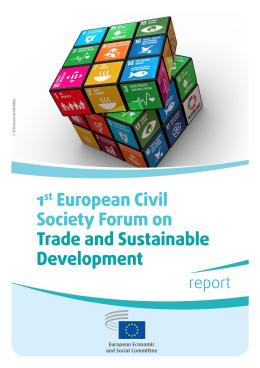
    Le 1er Forum européen de la société civile sur le commerce et le développement durable organisé par le Comité économique et social européen (CESE) s'est déroulé sous forme de réunion hybride le 29 mars 2022. Ce rapport et ses recommandations reflètent les discussions et le point de vue des différents intervenants.

  • Adopté on 25/01/2023 - Bureau decision date: 12/07/2022
    Référence
    REX/561-EESC-2022
    Workers - GR II
    Germany
    Session plénière
    575
    -
    Download format:
    Download — Avis du CESE: La force des partenariats commerciaux: ensemble pour une croissance économique verte et juste
  • Published in
    14 pages

    Ce manuel vise à présenter les groupes consultatifs internes (GCI) de l'UE décrivant leur mission, leur composition, l'organisation de leur travail et leurs relations avec les parties prenantes. Il fournit les informations nécessaires à tout nouveau membre d'un GCI et aux partenaires des pays tiers qui cherchent des informations sur les GCIs. Il compile également une liste de questions horizontales pour faciliter la coordination entre les GCIs.