The second meeting of the EU Domestic Advisory Group (DAG) under the EU–Kenya Economic Partnership Agreement (EPA), held on 13 April 2026 at the European Economic and Social Committee, brought together representatives from EU institutions, civil society, and international organisations to assess progress and discuss key priorities for implementation.
The Domestic Advisory Group (DAG) established under the EU–Kenya Economic Partnership Agreement (EPA) held its inaugural meeting on 27 October at the EESC. This is the first time that an EU EPA with an African country has included the creation of a DAG to monitor and advise on the implementation of the agreement.
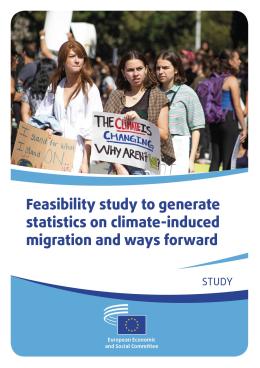
Cette "étude de faisabilité visant à générer des statistiques sur la migration induite par le climat et à envisager des pistes d’action" a pour but de rassembler et examiner les données existantes sur la migration induite par le climat, en se concentrant sur cinq États membres (France, Allemagne, Grèce, Italie et Espagne) et un pays candidat (Turquie), afin d’éclairer une réponse efficace de l’UE. Il n’existe pas de définition universellement acceptée de la migration induite par le climat.
welcomes the African Union’s (AU) commitment to democratic values and to promoting democracy as highlighted in the aspirations set out in the AU 2063 Agenda;
believes that the Global Gateway strategy is of great importance for EU-Africa relations, and reaffirms that it will strengthen economic and political ties, ensuring respect for democratic and social principles;
commits to pursue and improve its activities to promote and support African civil society organisations and social partners by facilitating their establishment, organisation and action and by helping boost their institutional capacity, as a contribution to achieving the EU’s goal of making democracy resilient in Africa.
Lors de sa session plénière de décembre, le Comité économique et social européen (CESE) a organisé un débat sur la démocratie en Afrique avec des représentants du Conseil économique, social et culturel de l’Union africaine (ECOSOCC de l’UA). Les parties partagent l’idée que la société civile est le véritable moteur d’un partenariat fructueux entre l’Union européenne et l’Afrique, qui se fonde sur l’égalité et favorise le dialogue civil et social.
Le Comité économique et social européen (CESE) et le Conseil économique, social et culturel (ECOSOCC) de l’Union africaine ont présenté ce jour une déclaration conjointe lors du Sommet de l’avenir organisé par les Nations unies à New York, laquelle met en avant le rôle crucial que joue la société civile pour remédier aux problèmes d’ordre mondial et faire progresser le développement durable.
On 17 July, the President of the European Economic and Social Committee (EESC), Oliver Röpke, signed a Memorandum of Understanding (MoU) with the African Union Economic, Social and Cultural Council (ECOSOCC) represented by its Presiding Officer, Khalid Boudali. The memorandum aims to formalise the partnership between the two institutions and enhance economic and social stakeholder involvement in the Africa-EU partnership.
Cette étude examine la participation des organisations de la société civile (OSC) à l'accord de partenariat économique (APE) entre l'Union européenne (UE) et les États de l'APE de la Communauté de développement de l'Afrique australe (CDAA)
Le Comité économique et social européen (CESE) organise des consultations régulières du Réseau des acteurs économiques et sociaux de l'Union européenne en Afrique, qui rassemble des représentants de la société civile organisée (employeurs et chambres de commerce, salariés et syndicats, coopératives, organisations paysannes, consommateurs ' organisations, ONG, etc.) des deux continents.
La 8e réunion du réseau des acteurs économiques et sociaux UE-Afrique se tiendra à Bruxelles, en Belgique, les 28 et 29 juin 2023, dans les locaux du CESE.
Cette édition, intitulée Le partenariat UA-UE pour un avenir durable, portera sur les sujets suivants :
Implication des partenaires économiques et sociaux dans l'accord post-Cotonou
Instruments de financement de l'UE pour l'action extérieure : examen à mi-parcours
Eau et nutrition : l'objectif Faim Zéro et la durabilité des ressources hydriques
Matières premières critiques: un partenariat mutuellement bénéfique pour le développement durable
Une déclaration politique sera adoptée par le réseau à la suite de cet événement.
La section «Relations extérieures» (REX) du Comité économique et social européen (CESE) est chargée du dialogue entre les organisations européennes de la société civile et leurs homologues des pays avec lesquels l’Union européenne entretient des relations formelles (par exemple sous la forme d’un accord de libre-échange). Grâce à ce dialogue, rendu possible par une série d’organes bilatéraux et par des avis spécialisés et des rapports d’information, le Comité est en mesure de contribuer concrètement à la politique étrangère de l’UE.