In this overview the European Economic and Social Committee (EESC) shares its opinions on the European Commission’s proposals for the Multiannual Financial Framework (MFF) 2028-2034, bringing together the perspectives of organised civil society on the future direction of the EU budget.
This paper examines the labour-market implications of artificial intelligence (AI) focusing on employment, distribution, and economic governance within the European Union. It presents the reader with the complicated literature around automation technologies, and their impacts on labour. Arguing that AI represents a qualitatively new phase of automation but continues to demonstrate similar trends to previous waves, only this time targeting routine cognitive and white-collar jobs.
The study assesses how a prospective EU Just Transition Directive (JTD) could shape the social and employment outcomes of the European Green Deal. Drawing on literature review, stake-holder interviews, foresight-based PESTEL scenario building and partial-equilibrium projections, it develops business-as-usual, as well as weak and strong JTD scenarios to 2045. The scenarios focus on seven Member States representing diverse welfare and production regimes.
This report, prepared for the EESC Workers' Group, analyses the question of defence in the European Union within its current state of play and its insertion into the broader debate of security
This study, commissioned by the European Economic and Social Committee, examines the state of implementation of the European Pillar of Social Rights and its Action Plan in 2024
The European Economic and Social Committee (EESC) on 19 June 2025 adopted a resolution to provide the European Commission with a contribution to its 2026 work programme.
This study aims to uncover why some countries in the EU have low or very low levels of collective bargaining coverage and propose policy recommendations to promote collective bargaining effectively.
The document highlights the Worker's Group priorities for 2023-2025. We want to shape a social and sustainable future that also upholds the principles of the rule of law, human rights, gender equality, solidarity and diversity. We strive to empower our democracy, society, and everyone in it. Our journey is an ongoing commitment, demanding unwavering determination as we strive to shape a society marked by shared prosperity and equality.
This study looks at the Conference on the Future of Europe’s (CoFoE) proposals on European democracy and the role of the European Economic and Social Committee (EESC). It explores different options for institutional reform of the EESC to best serve its purpose and increase citizens’ participation. To do this, the study examines different forms of participatory and deliberative practices, the current functions of the EESC, and the roles and structures of selected National Economic and Social Councils (NESCs).
Consequences for employment in regions undergoing energy transitions
This study examines the socio-economic situation of three lignite regions in the process of transitioning out of coal mining: Lusatia in Germany, Wielkopolska in Poland, and Upper Nitra in Slovakia. It assesses the effectiveness of various instruments, factors and approaches in creating quality jobs, employment, and economic growth.
Based on the evaluation of previous research and other documents, stakeholder interviews and consultation as well as an online survey, this report drafts possible futures of the European Economic and Social Committee (EESC).
This book, in partnership with CFDT Cadres, is presented as a legal guide for better mastering AI in our immediate environment. If we are faced with facial recognition during recruitment, the use of our personal data without our knowledge, if we are monitored by software during teleworking, that we depend on the arbitrary decision of an algorithm during a promotion, or even in our training course in the company, this book can help us to ask the right questions and to act.
This research report has been produced in the context of a project entitled ‘The definition of worker in the platform economy’ (CES/FSA/09/2020), which was commissioned by the workers’ group of the European Economic and Social Committee. The report aims to contribute to the debates on platform workers’ risks and regulatory solutions.
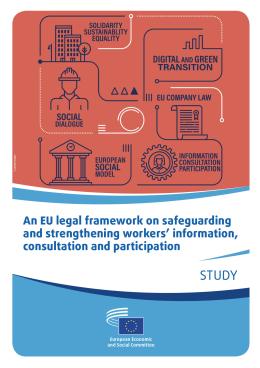
This study provides an overview of the current state of workers’ information, consultation and (board-level) participation in the European Union which are a key element of the Social Model as enshrined in the EU Treaties and a comprehensive body of secondary law.
This study examines the impact on the automatic stabilisation properties of national unemployment benefit systems of a European policy initiative that would introduce minimum standards to those systems.