European Economic
and Social Committee
European Economic
and Social Committee
The European Economic and Social Committee (EESC) is the voice of organised civil society in Europe.
Find out more about its role and structure at http://www.eesc.europa.eu/en/about
The EESC issues between 160 and 190 opinions, evaluation and information reports a year.
It also organises several annual initiatives and events with a focus on civil society and citizens’ participation such as the Civil Society Prize, the Civil Society Days, the Your Europe, Your Say youth plenary and the ECI Day.
Find the latest EESC opinions and publications at http://www.eesc.europa.eu/en/our-work/opinions-information-reports/opinions and http://www.eesc.europa.eu/en/our-work/publications-other-work/publications respectively.
The EESC is active in a wide range of areas, from social affairs to economy, energy and sustainability.
Learn more about our policy areas and policy highlights at http://www.eesc.europa.eu/en/policies
The EESC holds nine plenary sessions per year. It also organises many conferences, public hearings and high-level debates related to its work.
Find out more about our upcoming events at http://www.eesc.europa.eu/en/agenda/our-events/upcoming-events
Here you can find news and information about the EESC'swork, including its social media accounts, the EESC Info newsletter, photo galleries and videos.
Read the latest EESC news http://www.eesc.europa.eu/en/news-media/news and press releases http://www.eesc.europa.eu/en/news-media/press-releases
The EESC brings together representatives from all areas of organised civil society, who give their independent advice on EU policies and legislation. The EESC's326 Members are organised into three groups: Employers, Workers and Various Interests.
Find out more about our Members and groups at http://www.eesc.europa.eu/en/members-groups
The EESC has six sections, specialising in concrete topics of relevance to the citizens of the European Union, ranging from social to economic affairs, energy, environment, external relations or the internal market.
Find out more at http://www.eesc.europa.eu/en/sections-other-bodies
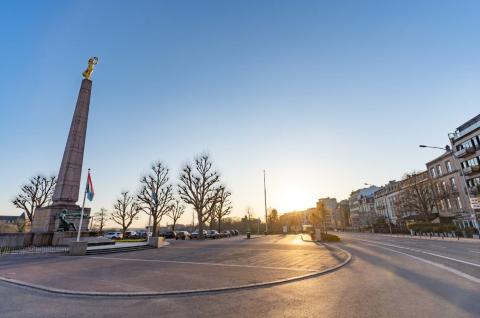
The streets have been deserted since the lockdown was declared. The most striking thing is the silence. Gone are the race for jobs, travelling abroad for a two hour meeting, the honking horns of city traffic, the bus that doesn't come...
Like so many others, we have complied with this forced confinement, trying our hardest to deal with this new way of life. While teleworking was easy for me, it was inconceivable for my husband, as his job and the infrastructure were (and are still) not suitable for it. This lack of suitability cost him several sleepless nights as a result of record absenteeism by his employees. Fear has spread at least as fast as the virus itself.
Now that the first wave has passed, I wonder what mental, social and economic condition we will be in when we emerge from this crisis. If the pandemic allowed for a new hierarchy of needs and environmental awareness, it has also borne witness to individual behaviours on a national and global scale. No one in Luxembourg would have believed that the borders could be closed again. Cross-border work is essential in the Grand Duchy and the restriction of free movement of people has led to fears such as a shortage of healthcare workers.
This crisis is also an opportunity for introspection regarding our own vulnerability. We are discovering that we are dependant, not only on healthcare workers, but also on each other's behaviour.
We will achieve the economic recovery together. Let's avoid nationalism and the collapse of economies while some countries discuss nationalising value chains in the name of resilience. Greater autonomy regarding globalisation should be considered at European level. With this crisis, we have the opportunity, for example, to stop for a moment, which should help us reflect on ourselves.