
European Economic
and Social Committee
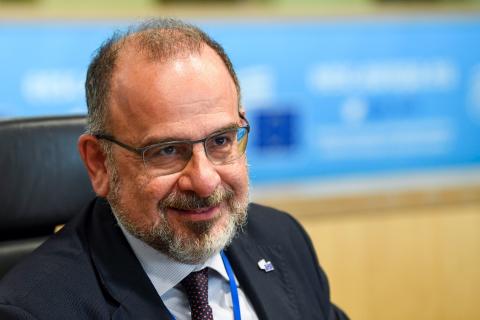
EESC info: What is the state of play of the implementation of the National Recovery and Resilience Plans in the Member States?
Luca Jahier: One year ago, we were at the very beginning of the process of implementing the Recovery and Resilience Facility, with only very few countries having made progress in the preparation of their national plans.
It was first and foremost essential to test and stress the importance of implementing Article 18 of the EU Regulation, concerning the obligation for Members States to involve civil society organisations as well as the social partners, local authorities, universities and other stakeholders, in preparing, implementing and monitoring the plans.
This year, 26 countries have finalised their plans (the Netherlands is in the final stages of doing so) and, with the exception of just two countries, on account of "rule of law" conditionality, all the others have already been approved and many are already in the implementation phase. Some plans have already been fully concluded, have received a positive EU assessment for the first six months' implementation and are fast advancing in the second six-month period. As such, there are many more elements on the practical application of Article 18 of the Recovery and Resilience Facility Regulation and the final content of National Recovery and Resilience Plan has now generally been assessed favourably by organised civil society.
Although there are many qualitative differences in civil society organisation involvement in the Member States, with some having had minimal involvement, some very good best practices have also been identified. For example, in Austria, France, Luxembourg, Spain and Sweden, there is close and constructive cooperation with governments, strengthened by transparency and ongoing dialogue. Moreover, in Czechia, Estonia, Finland, Italy and Spain, a Recovery and Resilience Facility campaign website or government portal has been implemented with transparent information that is accessible to the public. In Italy, a Permanent Round Table Partnership was established in November 2021 at government level, coordinated by the president of the National Economic and Social Committee. In Croatia, organised civil society is involved in preparing tenders for the implementation of the National Recovery and Resilience Plan. Finally, in Portugal, a National Monitoring Committee has been set up and includes, among others, representatives of the social partners, universities and the social sector.
And so, we can conclude that, firstly there is a need to further stress this point, inviting the Member States to adopt positive lessons and follow these best practices. Secondly, we can confirm that high-quality, effective and stable civil society organisation participation in economic governance in the Member States should be based on legal rules as well as on public and transparent procedures, guaranteed through an EU directive or regulation.