Green Deal europeo

This page is also available in:

L'11 dicembre 2019 la Commissione europea ha lanciato il Green Deal europeo, che rafforza l'impegno dell'UE ad affrontare le sfide legate al clima e all'ambiente, ovvero il compito che definisce l'attuale generazione. L'obiettivo del Green Deal europeo è trasformare l'UE in un'economia moderna, efficiente sotto il profilo delle risorse e competitiva, garantendo che:

  • le emissioni nette di gas a effetto serra siano azzerate entro il 2050;
  • la crescita economica sia dissociata dall'uso delle risorse;
  • nessuna persona e nessun territorio siano lasciati indietro.

Per realizzare il Green Deal europeo, l'UE sta attuando un pacchetto completo di iniziative, che comprende proposte politiche e legislative nonché lo sviluppo e la modernizzazione degli strumenti di finanziamento.

Il CESE ha chiesto un "Green e Social Deal", ossia un Green Deal che inglobi anche la dimensione sociale, sottolineando lo stretto legame tra questa iniziativa e la giustizia sociale. È essenziale ascoltare la voce di tutte le parti interessate al fine di promuovere le imprese sostenibili e competitive di domani in un ambiente sano.

Il Green Deal europeo ha posto un forte accento sugli investimenti e sul finanziamento della transizione verde e sostenibile. Il Green Deal è l'ancora di salvezza dell'Europa per uscire dalla pandemia di COVID-19. Un terzo dei 1 800 miliardi di EUR di investimenti del piano per la ripresa NextGenerationEU e del bilancio settennale dell'UE è destinato a finanziare il Green Deal. Questo aumento delle opportunità di finanziamento mira a far sì che la crisi diventi un'opportunità trasformativa per il futuro dell'Europa.

Il CESE svolge un ruolo cruciale nel monitorare l'attuazione delle iniziative e delle azioni del Green Deal europeo. Il CESE elabora pareri e organizza attività (cfr. menù a sinistra di questa pagina) per garantire che le istituzioni dell'UE tengano conto dei punti di vista della società civile organizzata e che le iniziative del Green Deal siano coerenti con le diverse situazioni economiche, sociali e civiche sul campo.

Data la sua natura trasversale e onnicomprensiva, il Green Deal europeo rientra nelle competenze di tutte le sezioni del CESE e della CCMI.

  • Published in
    20 pages

    Call for an EU Blue Deal - Event highlights - 26 October 2023

  • Published in
    8 pages

    The European Economic and Social Committee calls on the European institutions to consider water as a priority and to adopt an EU Blue Deal as a standalone strategic policy, on an equal footing with the EU Green Deal.

  • Published in
    Study
    80 pages

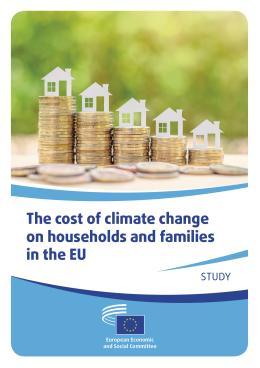
    This study investigates the major climate-related risks for households in the EU by quantifying the relationship between a set of selected climate-hazards metrics, households’ income by source, and sector-specific expenditures, capturing both the climate induced cost of impacts and adaptation measures. This analysis is complemented with the assessment of mitigation policy costs for households using a mixed modelling approach.

  • Published in
    Study
    61 pages

    The study reviews recent analyses to understand the green or circular skills of the future which have been identified thus far in sectoral and EU-wide research. Moreover, it examines EU Initiatives on skills development for circularity, by highlighting some limitations of these instruments and making suggestions for improvement.

  • Published in
    16 pages

    EESC Employers’ Group priorities

  • Published in
    12 pages

    Approach and priority areas of the Civil Society Organisations' Group for 2023

  • Published in
    24 pages

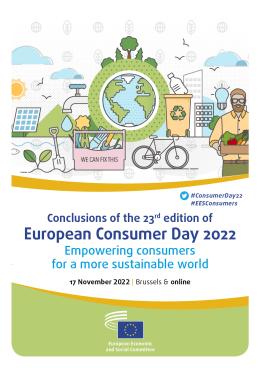
    Conclusions of the 23rd edition of European Consumer Day 2022 - 17 November 2022

  • Published in
    Study
    53 pages

    This study identifies key barriers to accelerating the renovation rate in the residential building sector and to implementing the Minimum Energy Performance Standards (MEPS). It provides a summary of, and recommendations for, overcoming these obstacles. 

  • Published in
    Study
    72 pages

    This study deals with the use of hydrogen for the de-carbonization of the Resources and Energy Intensive Industries (REIIs) and gives a specific insight of the situation of the steel-making industry.

  • Danish Presidency of the Council of the EU

    In this issue:

    • Our members write about their expectations and proposals for the Danish Presidency
    • Guest articles by Simon PRAHM (GAME), Per BACH (Social Entrepreneurs in Denmark) and Daniel VOCES DE ONAÍNDI (Europêche)
    • Interview with rapporteur Joe HEALY on 'Ensuring sustainable food production and a fair income for European farmers' (EESC opinion NAT/939)
    • Interview with the CEPS co-authors of the new EESC study 'Mapping civil dialogue practices in the EU institutions'
    • Reports on recent activities of the EESC Civil Society Organisations' Group
    • Civil Society Organisations' Bulletin - July 2025