604 Plenary session

This page is also available in:

  • At its March 2026 plenary session, the European Economic and Social Committee (EESC) adopted an exploratory opinion on how to ensure social inclusion and independent living for persons with disabilities through high‑quality, specialised social services. Building on the UN Convention on the Rights of Persons with Disabilities (UNCRPD), the Strategy for the Rights of Persons with Disabilities 2021–2030, and years of civil‑society advocacy, the Committee sets out a clear roadmap to close the gap between commitments and reality. 

  • At its March 2026 plenary session, the European Economic and Social Committee (EESC) adopted an exploratory opinion addressing how artificial intelligence and algorithmic management are reshaping work across Europe. Building on the Committee’s long‑standing engagement with social and employment policies, the opinion outlines a roadmap to ensure that AI strengthens workers’ rights, enhances job quality and supports a fair, competitive and inclusive digital transformation. 

  • In an opinion adopted at its March plenary on the review of the Sustainable Finance Disclosure Regulation (SFDR), the European Economic and Social Committee (EESC) calls for the EU’s sustainable finance framework to remain robust and aligned with the Green Deal. While supporting simplification, the Committee warns that the revision must preserve transparency, prevent greenwashing and keep capital flowing towards the green and social transition.

  • Reference number
    16/2026

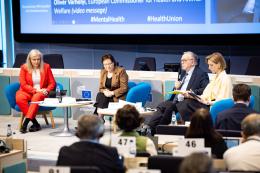
    The European Economic and Social Committee (EESC) placed the emotional well-being of children and young people at the centre of its March plenary session, holding a major three-part flagship debate that brought together EU institutions, international organisations, civil society and youth representatives. Speakers urged a coordinated push for prevention, safer digital spaces and stronger community support to protect young people’s emotional well-being.

  • In an opinion adopted at its March plenary session, the EESC calls for more ambitious reforms to integrate Europe’s capital markets and reinforce EU-level supervision, warning that persistent fragmentation is holding back investment, competitiveness and growth. Supporting the European Commission’s proposals for greater integration of capital markets and an efficient supervision system, the Committee stresses that only deeper market integration and coherent, streamlined supervision will allow EU capital markets to compete globally and allocate investment efficiently across the EU.

  • Reference number
    15/2026

    The debate held at the EESC March plenary highlighted the importance of stronger civil-military cooperation aimed at building trust. Military mobility is the key component of European independence and must focus on infrastructure, social respect and borders.

  • Reference number
    14/2026

    Following the third edition of Civil Society Week, the EU’s largest annual gathering of civil society representatives, the EESC reviewed its key outcomes in a plenary debate with EU institutions and stakeholders. With democratic values under growing pressure globally and across parts of the EU, civic participation is more important than ever.


  • The EESC:

    • stresses that military mobility is vital for EU deterrence and defence, particularly for frontline and transit Member States on the EU’s eastern flank and calls for rapid reinforcement of these regions as a top priority in implementing the Regulation. To achieve this goal,  simplification and harmonisation of logistics, customs, and transport rules are needed without undermining workers’ rights, working conditions and safety.
  • The EESC:

    • calls for proper funding for companies of all sizes and the involvement of a range of actors in collaborative and cross-border research and innovation partnerships, thereby enhancing the competitiveness of European industrial ecosystems and the EU’s economic security;