
European Economic
and Social Committee
EESC highlights urgent need to protect the emotional health of Europe’s young people
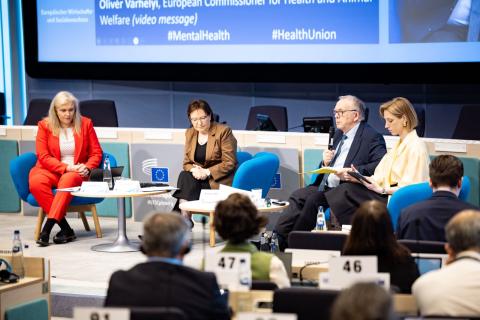
The European Economic and Social Committee (EESC) placed the emotional well-being of children and young people at the centre of its March plenary session, holding a major three-part flagship debate that brought together EU institutions, international organisations, civil society and youth representatives. Speakers urged a coordinated push for prevention, safer digital spaces and stronger community support to protect young people’s emotional well-being.
The debate highlighted that emotional health is becoming one of the defining challenges for Europe’s next generation, with rising levels of mental illness, anxiety, depression and suicide among young people. While health systems remain a national competence, the EU increasingly contributes through prevention, digital safety and cross‑sector support. Young people today face unprecedented pressures – from social media harms and cyberbullying to economic insecurity, loneliness and the lingering effects of recent crises.
Opening the debate, EESC President Séamus Boland underlined the urgency of addressing these issues: ‘For me, what is crucial is that this debate helps to bring the topic of emotional health and suicide out of the shadows; it is imperative that we destigmatise and demystify issues surrounding mental health. Communities, families and civil society organisations play a key role in those efforts.’
A growing crisis across Europe
The debate highlighted soaring levels of emotional discomfort among young Europeans, as well as persistent disparities in access to services. Many face long waiting times, insufficient child‑specific support and weak early‑intervention systems, leaving vulnerable groups – including LGBTQI+ young people, migrant children and those in rural or low‑income households – at particular risk.
The World Health Organization and UNICEF have warned that mental‑health conditions among young people are rising faster than in any other age group and urged stronger, more coordinated action.
Institutional perspectives and challenges
In the first panel, Ewa Kopacz, Vice‑President of the European Parliament, and Coordinator for Children’s Rights and Chair of the High-level Group on Gender Equality and Diversity, stressed that while mental health is more visible in public debate, support remains uneven across Member States. She called for improved prevention, digital literacy and child‑centred services, and noted that policy responses should also address shortcomings in related areas.
Latvian Minister for Culture Agnese Lāce highlighted the important role of culture in strengthening emotional resilience and well-being, pointing to successful national programmes. She emphasised that stronger cooperation between the health and culture sectors would help improve outcomes.
European Commissioner for Health and Animal Welfare Olivér Várhelyi outlined EU‑level action, including the Comprehensive Approach to Mental Health, the recently-launched EU Action Plan against Cyberbullying and the Safe Hearts Plan. Since 2023, the Commission has adopted a comprehensive package of 20 initiatives on mental health.
From evidence to action: building better mental‑health systems
The second panel examined emerging threats. MEP and Co-Chair of the Intergroup on Mental Health Maria Walsh warned of an ’epidemic’ of digital harms, pointing to the surge in deepfake abuse, of which young women and girls are overwhelmingly the victims.
EESC rapporteur for the opinion on Mental Health Community Services, Pietro Barbieri, stressed the dangers of re‑institutionalisation and called for community‑based, person‑centred support. The UNICEF Deputy Regional Director for Europe and Central Asia, Octavian Bivol, presented joint WHO-UNICEF efforts to strengthen early identification and school‑based support. Board member of GrowSPACE of Poland Dominik Kuc urged investment in psycho-education, improved regulation and safer online environments.
Closing the gaps in policy, prevention and support
Regional Advisor on Mental Health at WHO/Europe Dr Ledia Lazeri highlighted concerning trends: suicide is now the leading cause of death among 15-20‑year‑olds, problematic social‑media use has risen sharply and only a small number of EU Member States have adequate youth mental‑health policies in place.
Kadri Soova, Director of Mental Health Europe, said Europe no longer lacks awareness but lacks structural implementation. She called for a new EU Mental Health Strategy and a genuine ’mental health in all policies’ approach. President of theCzepczyński Family Foundation Damián Kupczyk stressed the importance of universal emotional and empathy education, noting that many school‑based disorders stem from unmet emotional needs and a lack of prevention. Ana Polanco, Vice-President for European Government and Public Affairs at Merck HealthCare, presented young people’s demands for fairer economic conditions, accessible psychological support, healthier digital environments and a right to disconnect.
Towards a stronger European response
Members called for closer cooperation across institutions, Member States and civil society to improve prevention, digital safety and access to quality services. Emotional health cuts across education, social policy, labour markets, digital regulation and family well-being; addressing it requires coordinated action.
The Committee strongly emphasises that protecting the emotional health of Europe’s youth must remain a political priority and that joint efforts are essential to ensure young people can grow up in safe, supportive and resilient environments