
European Economic
and Social Committee
EESC to discuss emotional health of young people in the EU at March plenary
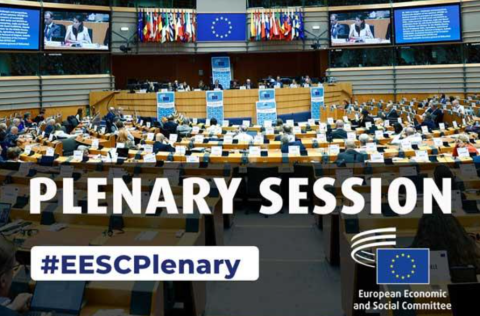
18-19 March 2026
European Commission, Charlemagne building (Alcide De Gasperi room), 1040 Brussels
Web stream click here
Debates
Wednesday 18 March 2026 at 15:00
Presentation of the outcomes of the Civil Society Week
with Nicolae Ștefănuță, Vice-President of the European Parliament; Hadja Lahbib, European Commissioner for Equality, Preparedness and Crisis Management (tbc); Hanna Surmatz, Member of the Liaison Group; Maria del Carmen Barrera Chamorro, European Citizen’s Initiative Group Chair; Pietro Barbieri, Cinzia Del Rio and Christa Schweng, rapporteurs-general for opinion SOC/840 on the EU strategy to support, protect and empower civil society adopted in May 2025
Wednesday 18 March 2026 at 16:30
Moving Europe in Times of Crisis: Military Mobility, Transport Resilience and their Social Dimension
with Petras Auštrevičius, Member of the European Parliament (tbc); Maja Bakran, Deputy Director-General of the European Commission’s Directorate-General for Mobility and Transport (DG MOVE); Hasit Bhaskarrai Thankey, Head of the Defence Enablement and Logistics Defence Policy and Planning Division at NATO; and Fabrizio Petrucci, CEO of Prometheus, linked to TEN/869 - Military mobility
Thursday 19 March 2026 at 10:00
Flagship debate on the emotional health of young people and children in the EU
with, among others, Ewa Kopacz, Vice-President of the European Parliament, European Parliament Coordinator for Children’s Rights and Chair of the High-level Group on Gender Equality and Diversity (EPP/Poland); Agnese Lāce, Minister for Culture of the Republic of Latvia; Olivér Várhelyi, European Commissioner for Health and Animal Welfare (via video message); Maria Walsh, Member of the European Parliament and Co-chair of the Intergroup on Mental Health (EPP/Ireland); and Pietro Barbieri, EESC rapporteur for opinion SOC/799 on Mental Health Community Services adopted in September 2024
Opinions in the spotlight
HOUSING
- Tackling housing scarcity through affordable, sustainable and family-oriented housing policies (TEN/866, rapporteur: Thomas Kattnig (AT-II))
In this exploratory opinion, requested by the Cyprus Presidency of the Council of the European Union, the EESC urges the European Commission to adopt far more ambitious measures to address the structural housing crisis, including better framework conditions, a right to adequate and affordable housing in EU primary law, a fundamental reform of the energy market design, sufficient funding and a stronger focus on young people, families and sustainability. More
ENERGY
- European Grids Package (TEN/863, rapporteur: Thomas Kattnig (AT-II))
The Committee supports expanding decentralised energy generation, which can reduce the need for grid expansion and strengthen public acceptance of the energy transition; and calls for stronger EU coordination in grid governance while maintaining Member States’ responsibility for planning and oversight when the costs of grid expansion, congestion management and stability are primarily national. More
TRANSPORT
- Military mobility (TEN/869, rapporteur: Tomas Arvidsson (SE-I))
The EESC explores the topic of military mobility and stresses that it is vital for EU deterrence and defence, particularly for frontline and transit Member States on the EU’s eastern flank. The Committee calls for rapid reinforcement of these regions as a top priority and for simplification and harmonisation of logistics, customs, and transport rules without undermining workers’ rights, working conditions and safety. More
- Clean corporate vehicles (TEN/862, rapporteur: Corina Andrea Murafa Benga (RO-III))
The Committee addresses the issue of emissions in corporate cars and vans, and recommends the European Commission to maintain a clear signal for zero and low-emissions vehicles. The EESC also calls on Member States to consider tax incentives for decarbonising corporate fleets, including by removing direct and indirect advantages for fossil-fuel company cars. More
INTERNAL MARKET
- Digital Omnibus (INT/1108, rapporteur: Heiko Willems (DE-I); co-rapporteur: Angelo Pagliara (IT-II))
The EESC takes note of the Commission's objective to simplify the EU's digital rulebook, stating that the reforms could strengthen Europe’s innovation capacity and competitiveness by reducing administrative burdens and overlapping rules. However, it stresses that simplification must not weaken core protections under the General Data Protection Regulation and the Artificial Intelligence Act, which safeguard fundamental rights such as privacy and data protection. The EESC supports a risk-based approach to AI regulation, lighter rules for lower-risk industrial uses, and stronger coordination between digital laws to avoid conflicting requirements. More
- Strategic Foresight Report 2025 (INT/1099, rapporteur: Philip Von Brockdorff (MT-II))
The EESC welcomes the Commission's 2025 Strategic Foresight Report but considers its analytical approach too closely aligned with current political trajectories, which limits its value for long-term strategic preparedness. To this end, multiple, divergent scenarios must be systematically used to stress-test strategies and policy assumptions. Future foresight reports must address radical disruptions and evaluate the costs of non-enlargement in a context that is increasingly security-driven world. More
SOCIAL AFFAIRS
- Social services for persons with disabilities (SOC/851, rapporteur: Pietro Vittorio Barbieri (IT-III))
The EESC calls for a binding EU directive to implement Article 19 of the UNCRPD and ensure a decisive shift from institutional to community‑based support. It urges mandatory national deinstitutionalisation strategies with clear budgets and indicators, stronger conditionality on EU funds to prevent financing of segregating settings, and investment in high‑quality, person‑centred social services. The Committee also calls for reform of outdated disability assessments, expanded data collection on legal capacity and institutionalisation, and improved accessibility of housing through coordinated use of ESF+, ERDF and InvestEU. More
- Quality in employment and working conditions (SOC/850, rapporteur: Nicoletta Merlo (IT-II))
The EESC calls for a human‑centred approach to the deployment of AI and algorithmic management, ensuring transparency, fairness and full respect for workers’ rights. It urges robust safeguards against discrimination and intrusive monitoring, stronger enforcement of GDPR and the AI Act, and mandatory assessments of the impacts of automated systems on working conditions. The Committee also calls for investment in digital skills, support for SMEs, and effective involvement of workers through social dialogue and collective bargaining. More
ENVIRONMENT
- EU Water Resilience Strategy and European Climate Resilience and Risk Management Integrated Framework (NAT/973, rapporteur: Anastasis Yiapanis (CY-III))
This exploratory opinion, requested by the Cyprus Presidency, highlights the strong links between water resilience and climate adaptation. It calls for better alignment between the European Water Resilience Strategy (2025) and the European Climate Adaptation Plan (2026) to address shared challenges such as droughts, floods, and ecosystem stress. The EESC stresses the need for joint prevention and risk-management mechanisms, wider deployment of nature-based solutions, and coherent financing and governance frameworks, while strengthening the resilience of infrastructure and communities across Europe. More
ECONOMY
- Sustainable Finance Disclosure Regulation review (ECO/693, rapporteur: Javier Doz Orrit (ES-II))
The EESC recommends to ensure that any simplification of sustainable finance legislation, including disclosure requirements, does not weaken the contribution of the financial system and its credit and investment products to achieving the objectives of the European Green Deal within the legally bound timelines, and does not weaken measures against greenwashing. More
- EU market integration and efficient supervision (ECO/694, rapporteur: Antonio García del Riego (ES-I))
The Committee considers that capital markets contribute to capital allocation and reflect a society's confidence in its own future. The EESC also calls on the co-legislators to support the objectives and measures set out in the European Commission’s proposals, stresses that more ambitious reforms are needed, and urges Member States to commit firmly to capital markets integration and to develop local markets. More
DEFENCE
- Roadmap for European Defence Readiness (CCMI/253, rapporteur: Christian Moos (DE-GIII), co-rapporteur: Christophe Tytgat (BE-Cat.1))
The EESC examined the EU’s roadmap to strengthen Europe’s defence readiness by 2030 in response to growing security threats following Russia’s war against Ukraine. It highlights the need for stronger coordination between Member States, faster capability development and major joint projects such as air and missile defence, anti-drone systems and space monitoring. More
- European Defence Industry Transformation Roadmap (CCMI/256, rapporteur: Maurizio Mensi (IT-GIII), co-rapporteur: Christophe Tytgat (BE-Cat.1))
The EESC calls for stronger investment and innovation to keep Europe at the forefront of defence technologies. It stresses the need to accelerate the development and production of critical systems, from drones and satellites to command-and-control infrastructure and secure cloud technologies. Strengthening the sector will help the EU respond to security challenges while reinforcing technological leadership and industrial resilience. More
TECHNOLOGY
- Battery Booster Strategy (CCMI/252, rapporteur: Jason Deguara (MT-II), co-rapporteur: Marco Mensink (NL-Cat.1))
The EESC backs the upcoming EU Battery Booster Strategy and calls for stronger action to scale up Europe’s battery industry. It calls for targeted investment, support across the battery value chain and measures to scale up EU manufacturing of battery cells and components. A stronger battery sector will be key to Europe’s industrial resilience and to advancing new technologies such as sodium batteries. More
- European Biotech Act and accompanying Directive on genetically modified micro-organisms (CCMI/257, rapporteur: Joan Roget Alemany (ES-I), co-rapporteur: Thomas Student (DE-Cat.2))
The EESC supports the EU Biotech Act and calls for stronger action to turn Europe’s world-class biotech research into marketable products and industrial production. It urges faster clinical trials, simpler EU rules, better access to scale-up funding and stronger support for EU-based biomanufacturing. More
For more information, please contact:
EESC Press Unit
E-mail: press@eesc.europa.eu
Tel: + 32 2 546 9793
@EESC_PRESS
Recommended for you
EESC highlights urgent need to protect the emotional health of Europe’s young people
News
The European Economic and Social Committee (EESC) placed the emotional well-being of children and young people at the centre of its March plenary session, holding a major three-part flagship debate…
Young people and mental health
Event
The EESC will hold a hybrid hearing in Brussels on 9 November 2023 from 2:30 to 5:30 pm on "Young people and mental health" In the event, we will discuss some of the factors affecting mental health…
Young people's mental health problems are deeply rooted in political decisions
News
Young people's mental health is being increasingly compromised by the excessive use of social media, concerns about climate change and a sense of powerlessness. This is a political issue for the EU…
Young People Discuss Democracy and Civic Engagement in Žilina
Agenda
Democracy, youth participation, and the strength of civil society were at the heart of a public discussion organised by the Slovak Youth Council this weekend at the Stanica Záriečie Cultural Centre…
Conference: The role of civil society organisations in ensuring the health security of children and young people within the EU
News
By the EESC Civil Society Organisations’ GroupThe topic of the conference, held on 15 May, was the mental and physical condition of young Europeans and the role of civil society…