Public services should not primarily be regarded as a cost to public finances, but as a strategic investment in democracy, social cohesion, economic development and the functioning of the EU. This is the core message of an opinion adopted by the European Economic and Social Committee (EESC) on how the sector can adapt to new challenges in the EU.
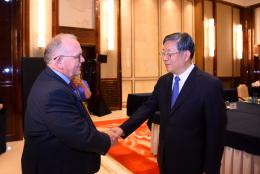
European Economic and Social Committee President Séamus Boland visited China from 13 to 18 September to strengthen cooperation and dialogue with the Chinese government, civil society organisations, trade unions, academics and social partners in a series of meetings and events in Hangzhou, Shanghai and Beijing.
At its September plenary, the European Economic and Social Committee (EESC) adopted key opinions on the European Commission’s long-awaited railway Passenger Package. The Committee recommends focusing on protection, transparency and inclusiveness for passengers, backing the establishment of a single digital booking system and multimodal mobility platforms.
With the UN's targets still off track for 2030, the European Economic and Social Committee (EESC) is calling for faster action. In a Resolution on the EU's priorities for 71st session of the United Nations Commission on the Status of Women (UN CSW71), the Committee highlights persistent barriers to women's economic independence and leadership, widespread gender-based violence and the need for stronger cooperation between EU institutions, Member States, social partners and civil society.
The EU’s next long-term budget cannot be reduced to a battle over numbers. At a high-level EESC debate with MEP Siegfried Mureșan, the European Commission, Germany’s Federal Foreign Office and leading researchers, one message was clear: if the EU wants to do more on security, competitiveness and climate resilience, it needs to equip itself with a stronger budget, and to do so without weakening cohesion and agriculture. Just as importantly, spending must work better, with the regions, the social partners and civil society involved from design to delivery.
On 15 September, the European Economic and Social Committee (EESC) will bring together civil society organisations, EU institutions and other stakeholders to help shape an ambitious, resilient and inclusive European contribution to the UN Water Conference, taking place on 8 – 10 December 2026.
In an opinion adopted at its July plenary, the European Economic and Social Committee (EESC) emphasises that drone technologies are evolving quickly and that future EU action should prioritise its ability to detect, prevent and respond to malicious activities in the European airspace. At the same time, Europe must develop its competitiveness and strategic resilience in this field while investing in people and skills.
Gender equality is not only a fundamental EU value, but also a driver of economic growth, competitiveness and democratic resilience, the European Economic and Social Committee (EESC) says in its opinion on the Gender Equality Strategy 2026-2030, adopted during its July plenary session.
With the European energy system facing deep geopolitical, economic and social transformation, the European Economic and Social Committee (EESC) argues, in a newly adopted opinion, that the EU now needs a clear, common plan for energy storage, something that is essential for energy independence and security of supply.