Pacte vert pour l’Europe

This page is also available in:

Le 11 décembre 2019, la Commission européenne a lancé le pacte vert pour l’Europe, réitérant ainsi l’engagement de l’Union à relever les défis climatiques et ceux liés à l’environnement, qui constitue une mission majeure de notre génération. L’objectif du pacte vert pour l’Europe est de transformer l’UE en une économie moderne, efficace dans l’utilisation des ressources et compétitive, caractérisée par:

  • l’absence d’émission nette de gaz à effet de serre d’ici à 2050;
  • une croissance économique dissociée de l’utilisation des ressources;
  • le souci de ne laisser personne de côté, socialement et géographiquement.

En vue de mettre en œuvre le pacte vert pour l’Europe, l’Union a lancé un ensemble complet d’initiatives, portant notamment sur des propositions politiques et législatives ainsi que le développement et la modernisation des instruments de financement.

Le CESE a plaidé en faveur d’un «pacte vert et social», soulignant le lien étroit entre le pacte vert et la justice sociale. Il est essentiel d’entendre la voix de toutes les parties prenantes afin de favoriser les entreprises durables et compétitives de demain dans un environnement sain.

Le pacte vert pour l’Europe met fortement l’accent sur l’investissement et le financement de la transition écologique et durable. Le pacte vert est la ligne de conduite de l’Europe pour sortir de la pandémie de COVID-19. Il sera financé par un tiers des 1 800 milliards d’euros d’investissements du plan de relance NextGenerationEU et le budget septennal de l’UE. Ces possibilités accrues de financement permettront à la crise de déclencher une dynamique transformatrice pour l’avenir de l’Europe.

Le CESE joue un rôle crucial dans le suivi de la mise en œuvre des initiatives et actions du pacte vert pour l’Europe. Le CESE prépare des avis et organise des activités (voir menu latéral à gauche de cette page) afin de veiller à ce que les institutions européennes tiennent compte des points de vue de la société civile organisée et que les initiatives du pacte vert soient cohérentes avec la réalité économique, sociale et civique sur le terrain.

En raison de sa nature transversale et globale, le pacte vert pour l’Europe relève de toutes les sections du CESE et de la CCMI.
  • Almost five years after it was launched, the Green Deal – Europe’s blueprint for a carbon-free Europe – has seen its implementation become increasingly complex. It is high time for a review of the green transition targets and to ensure they will not be achieved at the expense of Europe’s industrial and social systems, workers’ well-being and the EU’s competitiveness.

  • The EESC:

    • points out that there is still a long way to go to reach the final objectives of decarbonisation and transition to a more sustainable economy, objectives that were set out by the Commission in its original Green Deal formulation. Companies need much more certainty, global agreement, guidance, sophisticated accountability methods and, ultimately, support from legislators;
    • highlights the urgent need for public funds to be strategically allocated to goals that are jointly agreed on by European policy-makers and civil society. This initiative must be closely interlinked with the industrial strategy;
    • emphasises that Member States need EU-level support and civil society input to assist companies through guidance, benchmarking and shared learning capacities to adopt and carry out the structural reforms flowing from the Green Deal: bolstering employment rates, enhancing access to skills and labour, and promoting flexibility and efficiency in labour markets.
  • The EESC:

    1. while fully supporting the Green Deal and its objectives, points out the need to assess it in order to gauge its response to exogenic shocks, the geopolitical situation, and technological, social and economic developments, as well as to measure progress achieved thus far;


    2. calls on the European Commission to initiate the mapping of measures adopted under the Green Deal to address overlaps, conflicts and the cumulative administrative burden and to provide a publicly available online dashboard recording each Member State's progress in this domain;


    3. points out that the EESC itself should be empowered and endowed with the necessary resources to play the role of independent monitor of Green Deal implementation, since it is in a position to create a fact-based picture of the progress achieved within the different pillars of the Green Deal.
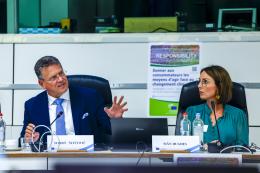
  • Maroš Šefčovič, Executive Vice-President of the European Commission, chose the conference Empowering consumers on climate change, hosted by the Civil Society Organisations' Group of the European Economic and Social Committee on 11 October, for his first green dialogue. Mr Šefčovič first spoke about the green dialogues at last week's European Parliament Committee on the Environment, Public Health and Food Safety hearing confirming that he would be responsible for the European Green Deal.

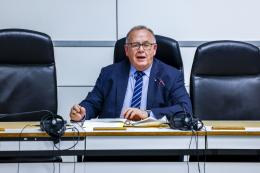
  • Inaugural speech at the conference on 'Empowering consumers on climate change' organised by the Civil Society Organisations' Group on 11 October 2023

    Séamus Boland, President of the Civil Society Organisations' Group

  • On 2 May 2023, the Liberal Professions Category of the EESC held the 7th edition of the Day of the Liberal Professions in Brussels. This annual event brings together key players from Europe's liberal professions, as well as key policymakers from the European Parliament, the European Commission and the Member States. This year's event was entitled Fostering skills and delivering the Green Deal.

  • The transition towards a low-carbon economy is a fundamental priority. But the green transition will fail without social dialogue. This represented a general agreement among the discussions during the meeting, particularly if climate policies were not made also socially sustainable and did not take into account the needs and worries of working people, of citizens. Key points raised during the debates included the fact that real wages were decreasing with the soaring inflation, the complementarity of fighting climate change and protecting social rights, and the fundamental role of involving Trade Unions in the design and implementation of policies within the Green Deal.

  • Academia, local civil society organisations, representatives of regional and national authorities and members of the European Economic and Social Committee met at a conference in Dolni Vítkovice, a former industrial area for coal mining and steel production in Ostrava, on 11 October 2022. The conference on Reinventing the Moravian-Silesian Region in search of a socially just transition was organised by the EESC's Civil Society Organisations' Group as part of the Czech Presidency of the Council of the EU.

  • Dans sa résolution sur la participation de la société civile organisée à la mise en œuvre et au suivi des plans nationaux pour la reprise et la résilience (PNRR), le Comité économique et social européen (CESE) plaide pour l’instauration de règles claires afin d’associer efficacement les partenaires sociaux et les organisations de la société civile aux stratégies des États membres destinées à remettre l’économie sur les rails.

  • Exposition de photos
    -

    À l’initiative du Groupe des organisations de la société civile du CESE, cette exposition présente des projets coordonnés par le cabinet d’architecture danois  BIG-Bjarke Ingels Group.