European Green Deal

This page is also available in:

On 11 December 2019, the European Commission launched the European Green Deal reinforcing the EU’s commitment to tackling climate and environmental-related challenges that is this generation’s defining task. The objective of the European Green Deal is to transform the EU into a modern, resource-efficient and competitive economy, ensuring:

  • no net emissions of greenhouse gases by 2050;
  • economic growth decoupled from resource use;
  • no person and no place left behind.

To deliver the European Green Deal, the EU is carrying out a comprehensive package of initiatives, including policy and legislative proposals and the development and modernisation of financing instruments.

The EESC has been calling for a "Green and Social Deal", stressing the close link between the Green Deal and social justice. It is essential to hear the voice of all stakeholders in order to foster the sustainable and competitive companies of tomorrow in a healthy environment.

The European Green Deal placed a strong emphasis on investment and the financing of the green and sustainable transition. The Green Deal is Europe’s lifeline out of the COVID-19 pandemic. One third of the 1.8 trillion euro investments from the NextGenerationEU Recovery Plan, and the EU’s seven-year budget finances the European Green Deal. This boost in funding opportunities aims to turn the crisis into a transformational opportunity for the future of Europe.

The EESC plays a crucial role in monitoring the implementation of the European Green Deal initiatives and actions. The EESC prepares opinions and organises activities (see side menu on the left of this page) to ensure the EU institutions take into account the views of organised civil society and the Green Deal initiatives are coherent with the economic, social and civic circumstances on the ground.

Due to the transversal and all-encompassing nature, the European Green Deal is covered by all EESC Sections and CCMI.
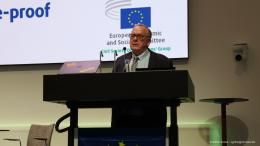
  • Conference of the EESC Civil Society Organisations' Group in the framework of the Danish Presidency of the Council of the European Union, Copenhagen, Danish Society of Engineers (IDA), 2 July 2025

  • Greater use of digitalisation in the construction and housing industry and the involvement of social economy actors in housing provision can bring opportunities to address current challenges in the area of housing affordability and sustainability in Europe. Since housing is not just a need but a human right, a pan-European response to the various challenges is needed, according to a conference organised by the Civil Society Organisations’ Group of the European Economic and Social Committee (EESC) on 21 November, at which a new EESC study on the subject was presented.

  • Almost five years after it was launched, the Green Deal – Europe’s blueprint for a carbon-free Europe – has seen its implementation become increasingly complex. It is high time for a review of the green transition targets and to ensure they will not be achieved at the expense of Europe’s industrial and social systems, workers’ well-being and the EU’s competitiveness.

  • The EESC:

    • points out that there is still a long way to go to reach the final objectives of decarbonisation and transition to a more sustainable economy, objectives that were set out by the Commission in its original Green Deal formulation. Companies need much more certainty, global agreement, guidance, sophisticated accountability methods and, ultimately, support from legislators;
    • highlights the urgent need for public funds to be strategically allocated to goals that are jointly agreed on by European policy-makers and civil society. This initiative must be closely interlinked with the industrial strategy;
    • emphasises that Member States need EU-level support and civil society input to assist companies through guidance, benchmarking and shared learning capacities to adopt and carry out the structural reforms flowing from the Green Deal: bolstering employment rates, enhancing access to skills and labour, and promoting flexibility and efficiency in labour markets.
  • The EESC:

    1. while fully supporting the Green Deal and its objectives, points out the need to assess it in order to gauge its response to exogenic shocks, the geopolitical situation, and technological, social and economic developments, as well as to measure progress achieved thus far;


    2. calls on the European Commission to initiate the mapping of measures adopted under the Green Deal to address overlaps, conflicts and the cumulative administrative burden and to provide a publicly available online dashboard recording each Member State's progress in this domain;


    3. points out that the EESC itself should be empowered and endowed with the necessary resources to play the role of independent monitor of Green Deal implementation, since it is in a position to create a fact-based picture of the progress achieved within the different pillars of the Green Deal.
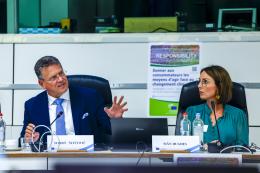
  • Maroš Šefčovič, Executive Vice-President of the European Commission, chose the conference Empowering consumers on climate change, hosted by the Civil Society Organisations' Group of the European Economic and Social Committee on 11 October, for his first green dialogue. Mr Šefčovič first spoke about the green dialogues at last week's European Parliament Committee on the Environment, Public Health and Food Safety hearing confirming that he would be responsible for the European Green Deal.

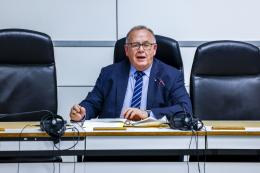
  • Inaugural speech at the conference on 'Empowering consumers on climate change' organised by the Civil Society Organisations' Group on 11 October 2023

    Séamus Boland, President of the Civil Society Organisations' Group

  • On 2 May 2023, the Liberal Professions Category of the EESC held the 7th edition of the Day of the Liberal Professions in Brussels. This annual event brings together key players from Europe's liberal professions, as well as key policymakers from the European Parliament, the European Commission and the Member States. This year's event was entitled Fostering skills and delivering the Green Deal.

  • The transition towards a low-carbon economy is a fundamental priority. But the green transition will fail without social dialogue. This represented a general agreement among the discussions during the meeting, particularly if climate policies were not made also socially sustainable and did not take into account the needs and worries of working people, of citizens. Key points raised during the debates included the fact that real wages were decreasing with the soaring inflation, the complementarity of fighting climate change and protecting social rights, and the fundamental role of involving Trade Unions in the design and implementation of policies within the Green Deal.

  • Academia, local civil society organisations, representatives of regional and national authorities and members of the European Economic and Social Committee met at a conference in Dolni Vítkovice, a former industrial area for coal mining and steel production in Ostrava, on 11 October 2022. The conference on Reinventing the Moravian-Silesian Region in search of a socially just transition was organised by the EESC's Civil Society Organisations' Group as part of the Czech Presidency of the Council of the EU.