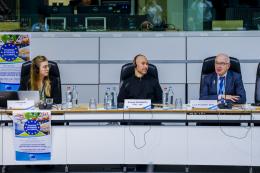
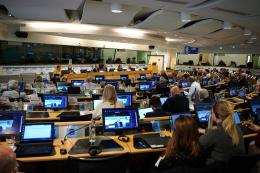
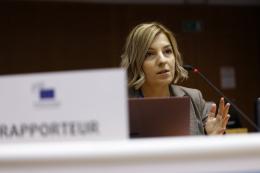
The European Economic and Social Committee held a plenary debate on the role of finance and public recovery policies in promoting gender equality and the economic empowerment of women in the EU. The discussion was linked to the adoption of two opinions: one on a gender-based approach to budgeting and investing and the other on how Member States can improve the way in which the direct and indirect measures proposed in their Recovery and Resilience Plans (RRPs) affect gender equality.
The EESC held a conference on the future of European strategic autonomy. The event was organised jointly by three Committee bodies; the Digital Transition and Single Market Observatory, the Labour Market Observatory and the Sustainable Development Observatory. Policy-makers, experts from organised civil society and academia, as well as youth representatives, gathered to discuss how to overcome current and future obstacles to a self-sufficient EU in times of great geopolitical tensions and multiple crises.
The EESC held a debate on gender-based investments in the Member States' national Recovery and Resilience Plans (RRPs). Following on from the European Gender Equality Week, the event gathered policy-makers, experts from organised civil society and academia to discuss, among other things, how EU countries can improve the impact of the measures proposed in their RRPs on gender equality during implementation and monitoring.
In two newly adopted opinions, the European Economic and Social Committee (EESC) gives updated views on the Commission's Annual Sustainable Growth Survey 2022, which outlines the upcoming economic and employment policy priorities for the EU, as well as on the Recommendations on euro area economic policy for 2022. The EESC calls for a balanced approach that does not jeopardise the EU's social and environmental goals.
The European Economic and Social Committee (EESC) and the European Commission unveiled an updated Protocol on Cooperation. The document further consolidates and intensifies the political and legislative cooperation between the two organisations, as well as their joint efforts to communicate about Europe.
The European Economic and Social Committee (EESC) held a conference on the prospects for the European economy in times of crisis. The event gathered high-level policy-makers, civil society representatives and economic researchers to see how the EU can tackle new dilemmas posed by low-growth prospects and record-high levels of inflation. All agreed that the war in Ukraine has only aggravated trends that have been going on for years. The main takeaways of the event were that fiscal policies need to be revised, that supporting productive investment amidst difficulties is key, and that vulnerable businesses and households need more public support.
In an own-initiative opinion, the European Economic and Social Committee (EESC) proposes creating a Climate Adjustment Fund (CAF) to ensure a rapid response to new climate and energy crises. The CAF would complement existing EU policies and ensure more effective use of existing funding.
Le Comité économique et social européen (CESE) presse la Commission de mettre fin au retard pris dans la publication de son rapport en vue d’étendre le champ d’application de la taxinomie de l’UE en matière de durabilité aux objectifs sociaux.
Le Comité économique et social européen est favorable à une réglementation accrue des crypto-actifs, assortie de règles solides et cohérentes visant à mieux protéger les investisseurs dans l’ensemble de l’UE, conformément aux mesures actuellement appliquées aux services financiers classiques.
Le CESE a tenu un débat en session plénière sur l’importance croissante de la société civile organisée et des villes pour mettre l’Europe en capacité de faire face aux chocs asymétriques et aux crises imprévues. Cet échange de vues est intervenu dans le contexte de l’adoption de deux avis, sur l’assistance flexible aux territoires (FAST-CARE) et sur l’accord de Ljubljana relatif au programme urbain pour l’UE. S’il se félicite de ces deux initiatives, le Comité estime qu’elles ne sont pas à la hauteur des enjeux lorsqu’il s’agit d’assurer l’autonomisation et la participation adéquates de la société civile organisée dans le cadre des efforts déployés pour parvenir à la résilience en Europe. Une mesure clé proposée par le CESE consiste à créer un fonds européen distinct pour la reconstruction et le développement de l’Ukraine afin de compléter les initiatives des États membres.