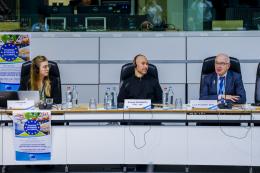
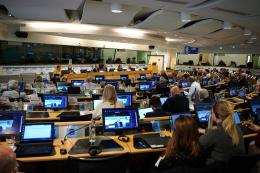
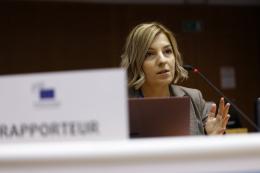
The EESC held a conference on the future of European strategic autonomy. The event was organised jointly by three Committee bodies; the Digital Transition and Single Market Observatory, the Labour Market Observatory and the Sustainable Development Observatory. Policy-makers, experts from organised civil society and academia, as well as youth representatives, gathered to discuss how to overcome current and future obstacles to a self-sufficient EU in times of great geopolitical tensions and multiple crises.
The EESC held a debate on gender-based investments in the Member States' national Recovery and Resilience Plans (RRPs). Following on from the European Gender Equality Week, the event gathered policy-makers, experts from organised civil society and academia to discuss, among other things, how EU countries can improve the impact of the measures proposed in their RRPs on gender equality during implementation and monitoring.
In two newly adopted opinions, the European Economic and Social Committee (EESC) gives updated views on the Commission's Annual Sustainable Growth Survey 2022, which outlines the upcoming economic and employment policy priorities for the EU, as well as on the Recommendations on euro area economic policy for 2022. The EESC calls for a balanced approach that does not jeopardise the EU's social and environmental goals.
The European Economic and Social Committee (EESC) and the European Commission unveiled an updated Protocol on Cooperation. The document further consolidates and intensifies the political and legislative cooperation between the two organisations, as well as their joint efforts to communicate about Europe.
The European Economic and Social Committee (EESC) held a conference on the prospects for the European economy in times of crisis. The event gathered high-level policy-makers, civil society representatives and economic researchers to see how the EU can tackle new dilemmas posed by low-growth prospects and record-high levels of inflation. All agreed that the war in Ukraine has only aggravated trends that have been going on for years. The main takeaways of the event were that fiscal policies need to be revised, that supporting productive investment amidst difficulties is key, and that vulnerable businesses and households need more public support.
In an own-initiative opinion, the European Economic and Social Committee (EESC) proposes creating a Climate Adjustment Fund (CAF) to ensure a rapid response to new climate and energy crises. The CAF would complement existing EU policies and ensure more effective use of existing funding.
Der Europäische Wirtschafts- und Sozialausschuss (EWSA) fordert die Europäische Kommission auf, einen längst überfälligen Bericht zu veröffentlichen und die Ausweitung des Anwendungsbereichs der EU-Nachhaltigkeitstaxonomie auf soziale Ziele zu prüfen.
The European Economic and Social Committee backs increased regulation of crypto-assets, with robust, coherent rules to better protect investors across the EU in line with current measures applied to traditional financial services.
The EESC held a debate in plenary on the growing importance of organised civil society and cities in Europe's ability to face asymmetric shocks and unforeseen crises. This was linked to the adoption of two opinions, on Flexible Assistance to Territories (FAST-CARE) and on the Ljubljana Agreement on the Urban Agenda of the EU. The Committee welcomes both initiatives, but finds they miss the bar in terms of properly empowering and involving organised civil society. A key measure proposed by the EESC is to create a separate EU fund for the reconstruction and development of Ukraine to complement the efforts made by the Member States.
Cohesion policy is key to overcoming the COVID-19 crisis, to achieving climate neutrality by 2050 and to reducing disparities in Europe. Its most serious challenge for the foreseeable future, however, is the war in Ukraine, the EESC cautions in a recent opinion. Rapid action is needed to help refugees and ensure the country's European integration.