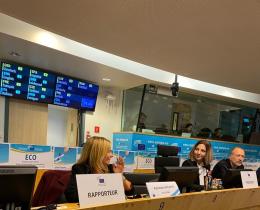
The hearing will gather stakeholders from civil society and institutions to look into the various forms of violence against women and girls that are not covered by 2024 Directive on gender violence. The objective will be to provide a perspective that truly contemplates a common comprehensive policy against gender-based violence, offering a comprehensive and effective strategy against this violation of human rights within the framework of the Union. Reflexions will feed into an Own-Initiative Opinion by the EESC FRRL Group.
Ten percent of women live in dire poverty. One in three women face violence. With a growing backlash against women's rights, unwavering commitment from both institutions and civil society is vital. A debate at the EESC plenary session underscored the need to keep up support for the fight for gender equality.
This year the UNCSW, the UN’s top annual meeting on gender equality, will focus on ending women’s poverty. During its inaugural participation in the event, the EESC will contribute to the theme with a declaration comprising ten action points for the economic empowerment and social protection of women
This own-initiative opinion stresses that any kind of violence against women is a violation of women’s human rights. The EESC believes Directive 2024/1385/EU on combating violence against women and domestic violence should address all forms of violence against women and calls for sexual violence and rape to be included as a form of violence and criminalised based on the absence of consent. Highlights that any kind of violence against women is a significant public and clinical health concern, while stressing the multiple and intersectional discrimination suffered by women with disabilities.
In Europe's rural communities, the silent struggle for equality and opportunity for young women is still ongoing. On 22 November, the European Economic and Social Committee (EESC) held a debate on gender equality and youth in rural areas during the meeting of its Section for Agriculture, Rural Development and the Environment. The event is in line with the EESC's commitment to the Rural Pact and the European Gender Equality Week.
Marking the International Day for the elimination of violence against women on 25 November, EESC member José Antonio Moreno Díaz, rapporteur for the opinion SOC/726 Combatting violence against women, believes that violence against women and girls is a tragedy that is sweeping Europe.
On 21 November, the EESC's Section for Employment, Social Affairs and Citizenship held a debate on the issue of violence against women and girls, calling for the local, national, regional and EU level to join forces. Despite years of procrastination, the Commission's proposal to combat violence against women was still watered down by the Council as the majority of Member States are not in favour of including consent-based rape legislation in the directive.
The EESC's Section for Economic and Monetary Union and Economic and Social Cohesion (ECO) held a debate on 15 November addressing gender disparities in access to financial markets. Studies highlight these gaps, sparking ongoing debates as to their causes. Women-led EU businesses receive only 2% of venture capital, apply for fewer loans and invest cautiously. The talks explored how these disparities affected society and the economy and searched for policy solutions.