
European Economic
and Social Committee
Civil society tackling societal polarisation
It’s April, and we’re still reflecting on the energy and insights sparked by our flagship events in March—events that once again demonstrated the power and determination of civil society.
March was indeed an intense and inspiring month at the European Economic and Social Committee. We hosted our annual youth event, Your Europe, Your Say (YEYS), where we hand the mic to Europe’s future: young people, many still in secondary school, from across the continent, including the UK and EU candidate countries.
We also held our second Civil Society Week, bringing together over 800 civil society representatives from across Europe to engage in lively discussions, exchange best practices, and co-create solutions aimed at strengthening democratic participation. This year we held it under the banner of Strengthening cohesion and participation in polarised societies.
In today’s turbulent times, there’s no shortage of pressing issues. So why focus on polarisation?
Polarisation—the sharpening of opposing views—can be a normal part of democratic discourse, often rooted in ideology. In fact, vibrant debate and the expression of diverse, even clashing opinions are vital to any open and pluralistic society like ours. As the EESC has often underlined, open and unrestricted debate is 'the foundation of a participatory society, without which democracy cannot function properly'.
Yet, the kind of polarisation we are seeing today is different. We are witnessing the rise of negative polarisation and populism that reject dialogue, erode trust, and undermine democratic values. In politics and public life, space for compromise is shrinking. When polarisation turns hostile—when it feeds hate or resentment—it disrupts social cohesion, fuels division, and in the worst cases, leads to violence.
By dedicating our event to polarisation, we wanted to point to the troubling rise of its toxic traits, which are slowly creeping into all pores of European societies.
This worrying trend is amplified by a number of threats: foreign interference in democratic processes, the spread of disinformation, and the manipulation of social media to silence opposing voices and promote extreme views. We are also seeing growing pressures on media freedom—whether through monopolisation, government interference, or attacks on journalists—at a time when free and pluralistic media are more essential than ever.
At the EESC, we are deeply concerned about the rise in hate-based crimes across Europe, including those targeting religion, sex, and gender. Hatred undermines democracy, weakens our institutions, and sows mistrust among citizens.
This is where civil society plays a crucial role. Civil society organisations have the drive and courage to defend democratic spaces, uphold fundamental rights, and strengthen the fabric of our communities. That includes pushing back against the toxic effects of negative polarisation.
Civil Society Week was our way of supporting that effort. It offered a space for meaningful dialogue, fresh ideas, and collaborative problem-solving aimed at fostering participation and social cohesion. We had Liaison Group panels on different topics, and a day dedicated to the European Citizens' Initiative (ECI) – the EU's ultimate tool for direct democracy.
As part of the week, the EESC also awarded its 15th Civil Society Prize to three outstanding initiatives combatting polarisation across Europe. Chosen from over 50 entries from 15 Member States, these projects show both the scale of the challenge and the deep commitment of civil society actors to meet it head-on.
I hope this year’s Civil Society Week and our prize winners will inspire renewed optimism and belief in the role civil society can play in defending and promoting European democratic values.
And while we are still reviewing the ideas, proposals, and takeaways from our March events, in this April issue we decided to give the floor to some of the voices from Civil Society Week and YEYS. I hope you enjoy the read.
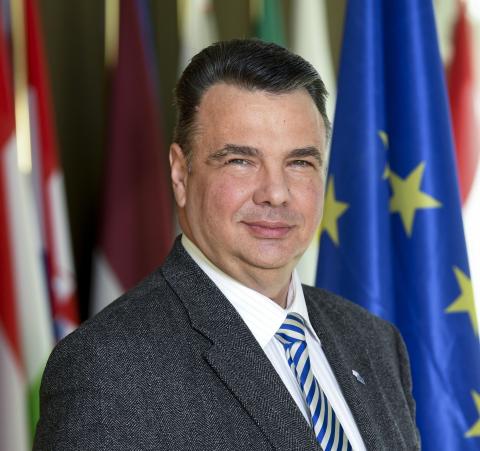
Laurenţiu Plosceanu
Vice-president for Communication