
European Economic
and Social Committee
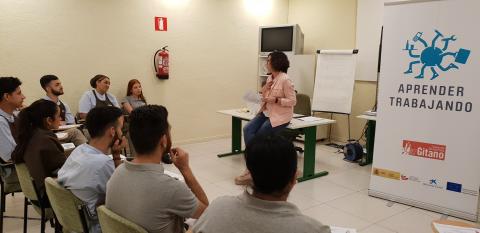
The first prize winner, Spain's Fundación Secretariado Gitano, launched its project Learning by Doing in 2013. In the 10 years of its existence, the project has enabled more than half of the young Roma who have taken part to get a job and a third to return to the education system to complete their compulsory secondary education. But most strikingly, 87% of the young people who participated say that their lives have improved and 94% of the companies who took part in the project by employing them said they would be prepared to do it again. Fundacion's Raúl Pérez told us more.
EESC info: What prompted you to start your project or initiative?
Aprender Trabajando (Learning by Working) was launched in 2013 at a time of severe global economic crisis which, in the case of Spain, resulted in high unemployment rates, among other things. Unemployment hit the youngest section of the population hard: "In 2013, the youth unemployment rate stood at an unacceptable 55.48%" (Youth and Labour Market Report, June 2014, Ministry of Employment and Social Security). In the case of the Spanish Roma population, 60% of whom are under the age of 30 and whose unemployment rate is usually three times that of the general population, the situation was aggravated by the fact that they often do not have the basic compulsory qualifications (only 17% complete compulsory minimum education) and have neither training nor previous work experience (66% of young Roma people are in neither education nor employment) (Comparative study on the situation of the Roma population in Spain with respect to employment and poverty (2018). Fundación Secretariado Gitano).
In response to this situation, various measures have been put in place at national level (e.g. the Entrepreneurship and Youth Employment Strategy 2013-2016) and at EU level (e.g. the Youth Guarantee). The Fundación Secretariado Gitano, which at that time was receiving funding through the ESF's Fight Against Discrimination operational programme in order to develop Acceder, a training and employment programme involving the Roma population, had the opportunity (provided by European funds) to test a new training model for young Roma people from vulnerable backgrounds.
How was your project received? Did you have any feedback from the people you helped? (Can you give an example if you have?)
During its 10 years of development, Aprender Trabajando has trained more than 3 500 Roma people under the age of 30, as beneficiaries of the national Youth Guarantee scheme who were not in education or employment. It has enabled 55% to enter employment, and 32% have returned to the education system in order to complete their compulsory secondary education. 87% of the young people who participated say that their lives have improved and 94% of the partner companies would be prepared to work with Aprender Trabajando again (according to Aprender Trabajando's 2013-2021 Executive Report).
Below you will find two testimonies from Aprender Trabajando alumni, which you can hear in the video produced to mark our 10th anniversary: 10 years. Aprender Trabajando, 2022:
"I was unemployed for two years. We ended up homeless, drifting from one place to the next, with no idea of where we would end up. I got in touch with Aprender Trabajando because I wanted to train and get a job." This is the testimony of Manuel Lizárraga, who participated in Aprender Trabajando at the Fundación Secretariado Gitano headquarters in Burgos. He is currently part of the workforce of the company Alcampo.
Maria Bruno proudly states: "I want to work and fulfil my potential as a person just like anyone else. Being Roma does not mean this is not possible." Maria took part in Aprender Trabajando in Madrid with the company Bricodepot, located in Getafe. "I really enjoy going to work. I love the place and am surrounded by wonderful people. They treated me as a person, not like the new girl or the new Roma."
How will you use this specific funding to provide further help in the community? Are you already planning new projects?
Since their inception, the Acceder and Aprender Trabajando programmes have been largely urban, developing in the main cities of Spain and often focusing on employment in the service sector, predominantly in urban areas. All of this limits their scope, leaving out the Roma population in rural areas, who, despite facing similar problems to those in cities in terms of discrimination or restrictions on their access to employment, do not have the same opportunities to access this kind of support.
One challenge would therefore be to extend this experience to as many Roma people as possible, adapting the model to reach those areas where a significant number of Roma people live, but where the organisation has no offices (mainly rural environments), and involving businesses from sectors other than the traditional sectors of trade and hospitality.
To this end, whenever circumstances allow, we plan to use these funds to finance a study (or part of a study) to adapt Aprender Trabajando's model to rural environments, and to new sectors other than trade and hospitality.
Should it ultimately not be possible to put the funds towards this study, they will be reinvested in the Aprender Trabajando project itself, by purchasing materials for the activities in the theoretical phase.
What advice would you give to other organisations in terms of achieving results with such activities and programmes?
- Any job integration project must include cooperation with companies throughout the design, implementation and monitoring process.
- It is important to start with pilot projects and anticipate further upscaling from the outset, if the experience proves to be positive.
- Introducing the role of tutors, both on the NGO side and on the company side, and ensuring that the communication and coordination process between the two is clear.
- Combining theoretical and practical training in real work environments as an effective avenue for training that matches the requirements of the labour market and as a way to promote subsequent employment opportunities.
- Adapting training courses and processes to the needs and circumstances of those targeted, in order to ensure that they have equal access to training and employment resources.
Do you think the EU is doing enough to help disadvantaged youth? Would you have any advice or recommendations for specific actions?
Mechanisms need to be put in place to ensure that countries (at state, regional or local level) implement effective projects to integrate the most disadvantaged young people into the labour market and that these projects actually reach those who need it most, such as the Roma population. It is essential to ensure interventions have a long-term approach, which is key to bringing about real changes in the lives of these young people.
Perhaps there could be greater co-financing of such projects by European funds in order to make it easier to invest in them in these terms.
Where any European financial resources involving recruitment are used (e.g. large investments being made or to be made under NextGenerationEU funds), there should be encouragement to include clauses for the recruitment of disadvantaged young people.