
European Economic
and Social Committee
Speech by President Séamus Boland, EESC plenary debate with Commissioner Kadri Simson
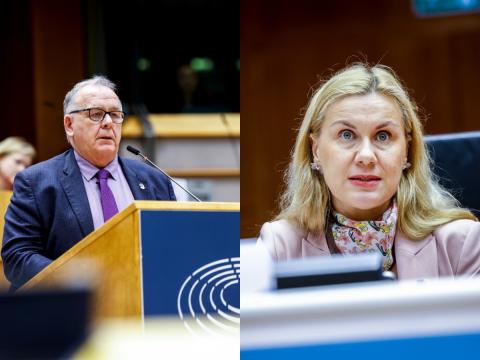
EESC plenary debate 'Beyond the crisis: which way forward for the EU energy policy?'
Speech by Civil Society Organisations' Group President Séamus Boland
Dear Commissioner,
Without doubt, the war against Ukraine has spurred investment in renewables giving them a significant strategic and economic edge:
- For the first time ever last year, global spending on wind and solar assets was greater than investments in oil and gas wells;
- And the green transition has accelerated by 5 to 10 years.
But not everything is positive:
- Last year, consumption for coal surpassed 8 billion tonnes for the first time in history;
- The International Energy Agency predicts that demand for coal will remain high until 2025.
In my opinion, when we reflect on the way forward for EU energy policy, we should keep in mind that the EU Energy Union is above all, a political project. Much like the Economic and Monetary Union and EU enlargement were in the past.
As a political project, three words come to my mind regarding the transition, namely: 'citizens, local and just'. Hence, my question to you Commissioner is: 'what will the EC do, to better involve citizens and to more effectively include the 'local' and 'just' perspectives in the EU's energy policy?'
It is my firm belief that citizens should be at the centre of the EU's energy system:
- We need a bottom-up approach with citizens as prosumers;
- I.e. citizens who take responsibility for the energy transition;
- Who use new technologies to reduce their energy bills;
- And who actively participate in the energy market.
Secondly, as renewables result in considerable costs for energy infrastructure, we should aim to produce and consume energy from local renewable sources.
Thirdly, I am adamant in my belief that:
- access to affordable energy is a right;
- and the energy transition must not result in energy poverty.
Civil society organisations are key to delivering a just transition:
- through their interactions with local government and their capacity to bring the topic out of the policy arena and into communities;
- respect, partnership and honest communication with communities must underlie this joint approach.
Ultimately, the overriding objective of the just transition must be to not leave behind any individual, community, economic sector or region. Thank you for your attention.
Work organisation
Downloads
-
Speech by Séamus Boland, EESC debate with Commissioner Kadri Simson