
European Economic
and Social Committee
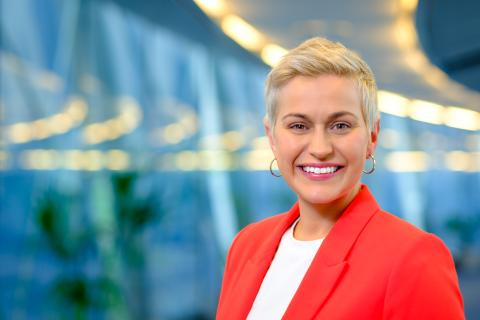
Irish MEP Maria Walsh is fighting to end period poverty. Her Plan for Periods is a call for action – a roadmap with concrete steps to make menstrual poverty a thing of the past across all 27 EU Member States. While some countries have taken positive steps, such as reducing ‘tampon tax’ or making period products available in schools, period poverty still isn’t at the top of the agenda for many governments. Yet ending it is not just about distributing pads and tampons, but about affording dignity and equality for millions of women and girls.
By Maria Walsh, MEP
When we speak about poverty, most people immediately think of food shortages, housing struggles or bills. Yet there is an element of poverty that is too often left out of the conversation: period poverty.
Period poverty refers to the inability to afford and access menstrual products. It has a higher prevalence among people with a low income, refugees, young people and people with disabilities.
Unfortunately, the harsh and deafening stigma surrounding menstruation exacerbates the problem, leaving many without the support they need and shrinking the space for action to be taken.
Menstrual health has been overlooked for far too long, having often been treated as a marginal concern. With menstrual poverty affecting an estimated 10% of the menstruating population in the EU, it is time to move beyond the narrative that this is solely a ‘women’s issue’ – it is a matter of public health and fundamental human rights.
I’m serving my second term as an MEP, and fundamental to both my mandates is ensuring that equality is not just talked about but met with reality across all sectors of society.
This is why I’ve proposed my Plan for Periods, a roadmap that sets out concrete steps to eliminate period poverty in the EU. Achieving this across all 27 Member States will ultimately require strong political commitment and coordination action.
This proposal seeks to end menstrual poverty, by taking into account policy and governance, access and affordability, education and awareness, research, and consultation with stakeholders. It is based on an intersectional and inclusive approach and sets out how the EU can lead in global action for menstrual health.
Some notable calls to action in my Plan for Periods include:
- an EU Action Plan on Menstrual Health: creating a formal strategy integrating menstrual health into EU frameworks on gender equality, education, health and poverty reduction;
- zero VAT on menstrual products: encouraging all Member States to fully remove VAT under the revision of the 2022 VAT Directive;
- public awareness campaigns: launching menstrual awareness campaigns in the 24 EU languages;
- research investment: it’s important to ensure funding for scientific research on menstruation, menstrual-related conditions (e.g. endometriosis), and product safety and innovation;
- menstrual leave guidelines: encouraging Member States to develop voluntary frameworks for menstrual leave or flexible working arrangements;
- including menstrual health in EU development aid and humanitarian policies.
I believe a proposal like this matters because menstruation is a biological fact of life for almost half the world’s population. And the reality is that when people cannot afford period products, the consequences ripple throughout all sectors of life. Young people skip school because they cannot manage their periods. Adults miss work. People’s reproductive health is impacted because they aren’t using safe products to manage their period.
So, addressing period poverty is not just about access to menstrual products, it is about ensuring dignity, equality, opportunity and prosperity.
I like to remind people that a Europe that strives for competitiveness cannot overlook the inequalities that hold people back. True competitiveness is only possible when we break down barriers, including period poverty, and build a Europe where everyone can participate fully and equally.
Indeed, there have been positive steps in recent years. Some EU Member States have removed or reduced ‘tampon tax’, acknowledging that menstrual products are not luxuries but essentials. In my Member State of Ireland, there is a commitment to make period products available in schools, following the lead of Scotland, which became the first country in the world to make period products free for all. Steps were taken in Spain in February 2023 regarding frameworks for menstrual leave, with the government passing a law which entitles women experiencing menstrual pain to paid time off work, provided that it is authorised by a doctor.
These policies are proof that change is possible.
But progress remains uneven. Many governments have yet to acknowledge period poverty as a policy priority. And across Europe, civil society organisations continue to shoulder much of the work without adequate support.
So ultimately, my proposal is a call to action. For too long, periods have been hidden in the shadows. But by speaking openly and by committing to action, we can change that. Ending period poverty is not just about distributing pads and tampons, it is about affording dignity and equality for every individual who menstruates.
Ending period poverty requires us to normalise the conversation. It requires policymakers to work hand in hand with educators, health professionals, NGOs and activists. It means the European Union needs to step up and show the way, making sure no one gets left out on the road to equality. I look forward to the European Commission’s Anti-Poverty Strategy, due to be published next year, to see what steps the Commission intends to take to combat period poverty.
First elected in 2019, and re-elected in 2024, Maria Walsh is serving her second term as a Fine Gael MEP in the European Parliament. She represents the Midlands-North-West constituency, which spans 15 counties across Ireland, and is a member of the EPP Group in the European Parliament. Ms Walsh sits on the European Parliament’s Committee on Agricultural and Rural Development (AGRI) and Committee on Women’s Rights and Gender Equality (FEMM) as a full member, and is also a member of the Committees on Civil Liberties, Justice and Home Affairs (LIBE) and on Regional Development (REGI). Her priorities include agriculture, regional development, women’s rights and mental health. She is a voice for farmers across the Midlands-North-West, for women and young girls and for all those who need mental health support and services.