In the context of the reinforced follow-up of EESC Information Report
-
Location
Edinburgh, Cardiff and London
United Kingdom
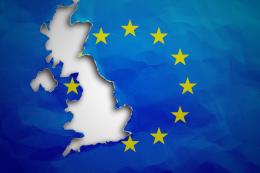
Following the adoption of the EESC Information Report on the Implementation of the EU-UK Withdrawal Agreement, the Committee is now promoting and giving it a reinforced follow-up using various communication channels, considering the relevance and the perfect timing of the subjects covered in the report.
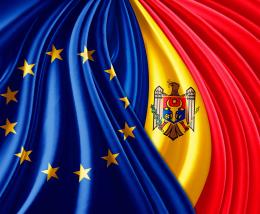
Representatives of the two Domestic Advisory Groups (DAG) from the EU and Moldova, established under Chapter 13 on Trade and Sustainable Development (TSD) of the Deep and Comprehensive Free Trade Agreement between the Republic of Moldova and the European Union, held the seventh joint meeting on 7 March 2023. The objective of the meeting was to prepare a set of recommendations for the Civil Society Forum, which will take place on 17 March 2023.
The EESC is organising a hybrid public hearing on "Towards a European Health Union and European Global Health Strategy fully inclusive of Persons with Disabilities " on 7th March 2023 am ( 9:30 am to 1 pm).
Despite being recognized by the UN Convention on the Rights of persons with Disabilities (UNCRPD) the right to the enjoyment of the highest attainable standard of health, persons with disabilities (pwd) are still victims of discrimination in access to healthcare both in the EU and at global level. The hearing, organised by the EESC Permanent Group on Disability Rights, will discuss what can be done to advance the rights of pwd in the field of health within the European Health Union and the EU Global Health Strategy.
Civil Society Organisations: a pillar of democracy and a key player to overcome current challenges
-
Location
Brussels
Belgium
War on European soil, post-pandemic recovery, democratic values under increasing pressure on both sides of the EU’s borders: these seismic shifts have left no doubt that civil society organisations are more important than ever - for both social cohesion and democracy in Europe. A strong, independent and diverse civil society is a key ingredient in ensuring a resilient democracy, able to safeguard both our fundamental rights and the integrity of our democratic way of life.
For the 16th time, the European Economic and Social Committee (EESC) and Montenegro held the Civil Society Joint Consultative Committee (JCC). The JCC is a civil society platform established between the EESC and Montenegrin civil society. It complements with a civil society point of view the EU institutional framework related to the Stabilisation and Association Agreement between the EU and Montenegro. This joint institution allows civil society organisations on both sides to monitor the country's accession negotiations. It is also a platform to discuss issues of common interest and to inform the public at large on the challenges ahead during the accession period.
This 16th JCC took place in Podgorica and tackled issues such as:
Current state of play in EU-Montenegro relations, including 2022 Montenegro Report
Revised enlargement methodology – Cluster 1: The Fundamentals of the Accession Process, with a special focus on Judiciary and Fundamental rights and the Functioning of democratic institutions
Revised enlargement methodology – Cluster 1: The Fundamentals of the Accession Process, with a special focus on Justice, Freedom and Security
Overview of the civil society situation in Montenegro
A joint declaration was adopted at the meeting and will be distributed to all relevant EU institutions, as well as to the Montenegrin authorities.
The EESC´s Consultative Commission on Industrial Change (CCMI) organised a hearing on the proposal for an EU cyber defence policy, with the participation of the European Commission and civil society stakeholders.
On 27 and 28 February 2023, the European Economic and Social Committee (EESC) and the European Commission will host the 2023 European Circular Economy Stakeholder Conference in hybrid mode. The sixth Conference will bring together Europe's biggest circular economy stakeholders to focus on the role of the circular economy in driving sustainable recovery, open strategic autonomy and resilience.
On 27 February 2023, a high-level hearing on water policies and challenges, entitled Time for a Blue Deal, will take place at the EESC. The hearing sets the scene for the EESC's cross-cutting work on water in 2023.
The hearing will focus on the most pressing water-related challenges now and in the years to come, and on what is the state of play regarding existing policies and actions. The discussions of the hearing will feed into the content of a package of own-initiative opinions on this thematic.
576th plenary session, with the following guests): Stefano Scarpetta, Director for Employment, Labour and Social Affairs, Organisation for Economic Co-operation and Development (OECD; Sviatlana Tsikhanouskaya, Leader of the Belarusian democratic movement, Oleksandra Matviichuk, Head of the Centre for Civic Liberties and Lora Pappa, Founder and President of the Greek NGO METAdrasi – Action for Migration Development . Web streaming
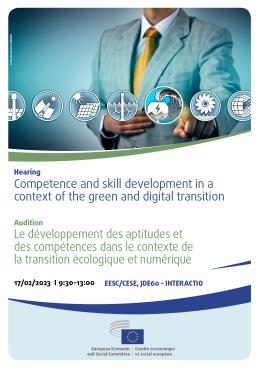
In order to prepare an exploratory opinion requested by the Swedish presidency, the EESC is organising a virtual public hearing on ''Competence and skills development in the green and digital transition'' on 17 February 2023.
Working life is transforming due to the accelerating digital transformation, automation, and transition to climate neutrality. The event will be looking at the competences and skills that will be needed in view of this transition, contributing to the debate in view of the European Year of Skills.