
European Economic
and Social Committee
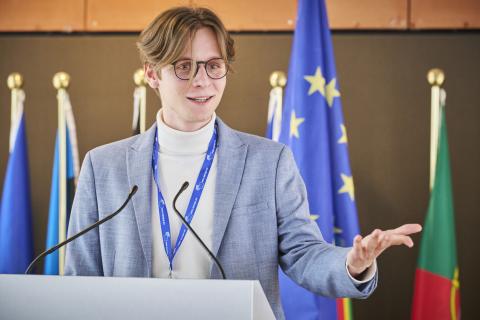
‘We teach students that facts must be verified, but opinions should be respectfully discussed. True critical thinking respects a plurality of views’, says Richard Vaško of the Slovak Debate Association (SDA), winner of the EESC’s Civil Society Prize on combatting polarisation with its Critical Thinking Olympiad. Richard, whose project won the first prize, spoke to us about the Olympiad and why teaching critical thinking is crucial in today’s polarised, disinformation-driven world.
Could you describe one game or round of the Critical Thinking Olympiad? Can you give an example of a task or question?
In the school and regional rounds of the Critical Thinking Olympiad, students take part in one-to-two-hour-long tests, with full access to the internet and online fact-checking tools, in which they solve a series of tasks. The challenges focus on media literacy, detecting manipulation and bias, interpreting data and studies, identifying logical fallacies and formulating their own arguments.
For example, in a recent round, students were asked to write an argument on whether ‘security cameras should be installed in schools to increase safety’ – a timely issue in the Slovak public discourse. Another task required them to analyse a viral TikTok video promoting a conspiracy theory about Taylor Swift and identify typical features of conspiratorial thinking. In a third challenge, they had to decide which of the two videos was AI-generated and which was authentic.
All previous tests are publicly available in Slovak at www.okm.sk.
What are you trying to achieve with the CTO? What prompted you to start the project?
Our goal is to help students at the age when they begin using social media and consuming digital content to develop the skills to navigate this space critically, responsibly and thoughtfully. Through regular feedback after each round and through e-learning courses available for preparation, students gain transferable habits and tools that they can apply in everyday life. Ultimately, we aim to nurture a generation of young people who are informed, resilient against disinformation and capable of leading a fact-based, constructive dialogue.
We launched this project in response to a critical gap in our education system: media literacy and critical thinking are still vastly underrepresented in formal curricula. Over half of Slovak students never learn how to evaluate whether information is trustworthy. Only 16% of Slovak youth regularly verify information from the media. As a result, 56% of the population tends to believe conspiracy theories or outright lies. We wanted to change that by introducing a scalable and impactful action to schools across the country.
Why do you think developing critical thinking is so important in the current context? Do we stand a chance of winning the war against fake news?
Fake news has always existed in some form, but we are now living in an era of unprecedented information overload. With social media as the primary information source for many young people, anyone can easily spread disinformation, misinformation or hate speech. Learning how to filter and navigate this chaotic information landscape has become a crucial life skill.
Nonetheless, we will never fully ‘win’ the war against fake news – it’s a moving target, constantly evolving. But what we can do is equip young people with the tools to better orient themselves in this environment, to ask good questions and to think before they share.
Have you received any feedback about your project? Can you give an example?
We collect detailed feedback after each round, and the responses are overwhelmingly positive. For instance, 93% of teachers whose students participated in the Olympiad said that it helps build their students’ resilience against disinformation and hoaxes. Moreover, our Net Promoter Score – a key metric of user satisfaction – reached +76 in the last round, which is considered excellent.
What advice would you give to other civil society organisations in terms of achieving results with such activities or programmes?
Every country and context are different, and local organisations know best what works for their communities. But the following are a few principles that have worked well for us:
Firstly and most importantly, we don’t tell young people what to think. True critical thinking respects a plurality of views. If students feel that their opinions are being dismissed or dictated to, they disengage. We teach them that facts must be verified, but that opinions should be respectfully discussed.
Second, accessibility and inclusivity are key. Unless we ‘burst the bubble’ and reach beyond elite schools, we won’t have real impact. Our programme is free, fully online, low-barrier and also available in the language of our largest ethnic minority. This year, 53% of participants came from vocational high schools.
Third, thinking about scalability from the beginning and leveraging new technology to achieve it. We use AI to grade open-ended responses, which allows us to maintain a high-quality educational experience without resorting to multiple-choice testing. While the digital age has brought serious challenges, it also provides us with powerful tools to address them.
Richard Vaško has been with the Slovak Debate Association (SDA) since he was 12. He won the Slovak National Debate League in high school and represented Slovakia at the World Schools Debating Championships. He graduated top of his class in Law, Politics and Philosophy at the University of Warwick, UK, and is now studying for an MPhil in Education (Knowledge, Power, Politics) at the University of Cambridge.
Since 2021, Richard has worked at the SDA, where he founded and now coordinates the Critical Thinking Olympiad. He has also worked with the Slovak Ministry of Education’s Strategic Communication team (StratCom) and co-authored teacher training handbooks on media literacy for the National Institute of Education and Youth. He conducts research and organises a multi-ethnic summer school for disadvantaged children with the Mathias Bel Institute, an NGO focused on ethnic minorities and marginalised Roma communities in Slovakia.