
Internationaler Handel

This page is also available in:

Im Bereich des internationalen Handels besteht ein komplexes System weltweiter Regelungen, die im Rahmen von Vereinbarungen der Welthandelsorganisation sowie bilateralen und multilateralen Abkommen beschlossen wurden. Die Freihandelsabkommen wirken sich zunehmend auf die Bürgerrechte aus. Gemäß dem Vertrag von Lissabon muss die EU-Handelspolitik unter Berücksichtigung der Grundsätze und Ziele der Außenpolitik der Union gestaltet werden. Hierzu gehören die Förderung der Rechtsstaatlichkeit, der Menschenrechte und der nachhaltigen Entwicklung.

Der EWSA ist der Auffassung, dass dies ein Leitprinzip für die Handelsverhandlungen und ‑beziehungen der EU sein sollte. Er gewährleistet die Konsensbildung von Unternehmen, Arbeitnehmern, Freiberuflern, Landwirten, Verbrauchern und anderen wichtigen Interessenträgern und schafft damit einen echten Mehrwert. Er leitet die Standpunkte der Zivilgesellschaft und Interessengruppen sowohl bei den Verhandlungen über Handelsabkommen als auch bei deren Umsetzung auf effiziente Weise an die internationalen politischen Entscheidungsträger weiter. Er hat einen Begleitausschuss Internationaler Handel eingerichtet, um sicherzustellen, dass die Zivilgesellschaft in die Gestaltung der EU-Handelspolitik einbezogen wird. Zudem leitet er die Internen Beratungsgruppen, die auf Grundlage der Kapitel „Handel und nachhaltige Entwicklung“ in den EU-Handelsabkommen der neuen Generation eingerichtet wurden. Aufgabe dieser Beratungsgruppen, denen Vertreter der Zivilgesellschaft (u. a. aus den Reihen des EWSA) angehören, ist es, Probleme im Bereich Handel und nachhaltige Entwicklung aufzuzeigen, die bei der Umsetzung eines Handelsabkommens auftreten können.
  • Event type
    Meeting

    During the meeting, the Commission representative provided information about the implementation of the project on labour standards delivered in cooperation with the ILO in El Salvador and Guatemala. The Commission also informed about preparations for meetings with Central America planned for 15-17 June in Honduras, in particular meeting of the intergovernmental Board on Trade and Sustainable Development. The EU Advisory Group then discussed preparations for the civil society meetings with Central America, which this year will include a workshop on market access, a joint meeting of the Advisory Groups and an open Civil Society Dialogue Forum. In the afternoon, a video-conference with Central American partners took place to discuss preparations for joint meetings.

  • Event type
    Meeting

    During the meeting, the EU DAG had an opportunity to discuss with Mr. Helmut Scholz, Member of the European Parliament, implementation of the Trade and Sustainable Development Title and work of the civil society monitoring mechanism in the framework of the EU-Colombia and Peru Trade Agreement. Moreover, the representatives of the European External Action Service (EEAS) presented information about the EU relations and cooperation with Colombia and Peru. Based on the Second Annual Report, the Commission representative provided information about the implementation of the Trade Agreement, changes in trade flows and work of joint bodies. He also informed about the procedures and timeline related to Ecuador's accession to the Agreement. The EU DAG discussed also with the Commission preparations for the next meeting with Colombia and Peru under the Trade and Sustainable Development Title, as well as the ways to better communicate its activities to the partners and other relevant stakeholders.

  • -
    Event type
    JCC Meeting

    The Consultative Committee (CC) is one of the 5 institutions foreseen in the EU-CARIFORUM Economic Partnership Agreement. The CC is composed of 40 (25 from the CARIFORM side and 15 from  the EU side)  standing representatives of organisations of the civil society  representing employers' organisations, trade unions, other economic, social and non-governmental organisations, including development and environmental organisations; and the academic community.

  • Event type
    Meeting

    During the meeting, the representative of the European External Action Service (EEAS) presented information about the EU relations and cooperation with Central America. Based on the Second Annual Report, the Commission representative provided information about the implementation of the trade pillar of the Association Agreement, changes in trade flows and work of joint bodies established by the Agreement. The EU Advisory Group discussed also preparations for the next meeting with Central America under the Trade and Sustainable Development Title, as well as the ways to better communicate its activities to the Central American partners and other relevant stakeholders.

  • Published in
    Study
    72 pages

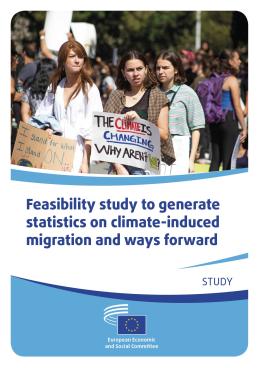
    This feasibility study to generate statistics on climate-induced migration and ways forward sought to gather and review existing data on climate-induced migration, focussing on five Member States (France, Germany, Greece, Italy and Spain) and one candidate country (Türkiye), to inform an effective EU response. There is no universally agreed definition of climate-induced migration. The majority of population movements as a result of rapid onset events takes place within a country as opposed to across borders.

  • Published in
    16 pages

    EESC Employers’ Group priorities
    This document presents the short- and mid-term objectives of the EESC Employers’ Group and 10 policy actions for policymakers to improve the business environment, and thereby the EU’s competitiveness and conditions for creating prosperity for citizens.

  • Published in
    Study
    57 pages

    The study looks at the involvement of Civil Society Organisations (CSOs) in the Economic Partnership Agreement (EPA) between the European Union (EU) and the Southern African Development Community (SADC) EPA States

  • Published in
    15 pages

    This document seeks to provide input to the Global Coalition for Social Justice. It highlights key messages from EESC opinions on the six priority areas identified by the International Labour Organization (ILO) for immediate action.

  • Published in
    8 pages

    The External Relations Section (REX) of the European Economic and Social Committee (EESC) is responsible for dialogue between European civil society organisations and their homologues from the countries with which the European Union has formal relations (e.g. under the form of a Free Trade Agreement). Through this dialogue, made possible by a series of bilateral bodies, and through specialized opinions and information reports, the Committee is able to concretely contribute to EU foreign policy.

  • Published in
    Study
    83 pages

    Study of the EESC Employers' Group together with the Centre for European Policy Studies (CEPS) – final report