
European Economic
and Social Committee
#RareDiseases - The EU Action Plan must step up European-national cooperation
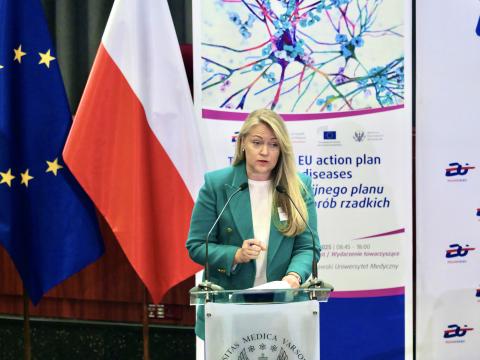
A high-level conference convened in Warsaw under the auspices of the Polish Presidency of the Council of the European Union highlighted the importance of adopting a comprehensive Europe-wide policy framework on rare diseases.
The European Union needs a European Action Plan on Rare Diseases that complements existing legislation, promotes investment, and enhances cooperation at EU and national levels.
Experts and policymakers gathered in Warsaw on 10 April 2025 for the conference Towards an EU action plan on rare diseases, to discuss the future direction of rare disease policy in Europe. The event, organised by the European Economic and Social Committee (EESC), the Polish Ministry of Health and the Medical University of Warsaw, highlighted the urgent need for a comprehensive European policy framework aimed at improving the lives of patients with rare diseases, setting clear and measurable objectives.
To this end, it is crucial to continue driving forward the EU’s political commitment in this area and to provide a platform where stakeholders can work together, share knowledge, and make progress towards a unified European response to rare diseases.
Patients need urgent responses
The European Commission and EU Member States should prioritise creating and implementing an EU-wide Action Plan that addresses the diverse needs of patients and healthcare providers. This initiative would significantly enhance the EU’s response to rare diseases, close care gaps, and improve outcomes for those affected.
Rare diseases affect more than 36 million people across Europe, yet access to timely diagnosis, treatment, and coordinated care remains uneven across Member States. National rare disease plans play a crucial role in addressing these challenges, but greater European cooperation is essential to make sustainable progress possible.
Ensuring timely access to care for rare disease patients requires well-organised healthcare systems that integrate specialised expertise and resources. Effective collaboration between European Reference Networks (ERNs) and national healthcare systems is essential to improve patient pathways and referral mechanisms.
Access to effective treatments remains challenging due to regulatory, economic, and research-related hurdles that delay innovation and availability.
The war in Ukraine has created significant barriers to treatment and care for Ukrainian citizens with rare diseases. Poland and the EU have shown solidarity and mutual support in addressing these challenges.
Another important point is early and accurate diagnosis, as timely identification of conditions enables better management, targeted treatments, and better long-term outcomes. Advances in genomics, screening programmes, and data-sharing initiatives such as the European Health Data Space (EHDS) offer new opportunities to reduce diagnostic delays and improve patient outcomes.
High-level speakers look to the future
The event saw the participation of leading experts and followed up on the EESC opinion Leaving No One Behind: European Commitment to Tackling Rare Diseases and previous conferences held by the EESC on the topic in Budapest and Brussels in 2024 and in Bilbao in 2023.
‘In recent years, the EESC has been a steadfast advocate for a European Action Plan on Rare Diseases that addresses the diverse needs of patients and healthcare providers.We need to ensure equal opportunities for rare disease patients across all Member States and set additional measures to support health authorities at the national, regional, and local levels, as well as civil society organisations, in their efforts to provide high-quality and affordable care for rare disease patients.’
Baiba Miltoviča, President of the Section for Transport, Energy, Infrastructure and the Information Society, EESC
‘Following the impactful EESC conferences organised with the EU Council Presidencies in Bilbao, Brussels, and Budapest, I am grateful to the Polish and upcoming Danish Presidencies for advancing towards a European Action Plan on Rare Diseases and hope the Cyprus Presidency will follow. We must provide optimal support for patients with rare diseases, ensuring access to early diagnosis, prevention, and affordable treatment, regardless of their location within the EU.’
Ágnes Cser, EESC member, rapporteur for the EESC opinion Leaving No One Behind: European Commitment to Tackling Rare Diseases
‘Patients with rare diseases need rapid diagnosis and effective therapy. Reducing the time from the onset of symptoms to diagnosis, by improving access to genetic diagnostics and supporting research into new treatments, is a priority. Deepening cooperation in this area makes it possible to ensure effective help for people with rare diseases. A joint strategy by the Member States will enable better access to diagnostics and therapies throughout Europe.’
Izabela Leszczyna, Health Minister, Poland
‘An important element of an efficient patient care system is the identification and establishment of Rare Disease Expertise Centres to ensure the best possible care for patients with rare diseases and close cooperation with European Reference Networks. For better monitoring of processes, we are developing IT tools – the Polish Rare Disease Registry and the electronic Patient Card with a rare disease – new information and data resources to improve care and increase patient safety.’
Urszula Demkow, Undersecretary of State, Ministry of Health, Poland
‘Rare diseases affect millions of people in the EU, and only 6% of them have treatment options, and not in every EU country. We must end the ‘geographical health lottery’ of unequal access to experienced specialists. The pandemic has created grassroots public support for greater European involvement in health and we cannot be oblivious to these public expectations. In the case of rare diseases, Europe may be the most appropriate response.’
Adam Jarubas, Chair of the European Parliament Committee on Public Health
Work organisation
Downloads
-
#RareDiseases - The EU Action Plan must step up European-national cooperation
Recommended for you
EWSA: Die EU muss die soziale Nachhaltigkeit stärker ins Blickfeld rücken
News
Der Europäische Wirtschafts- und Sozialausschuss (EWSA) fordert die Europäische Kommission auf, einen längst überfälligen Bericht zu veröffentlichen und die Ausweitung des Anwendungsbereichs der EU…
Ko-Kreation von Dienstleistungen von allgemeinem Interesse im Bereich Gesundheit als Beitrag zur Stärkung der partizipativen Demokratie in der EU
News
Bei dieser vom Europäischen Wirtschafts- und Sozialausschuss (EWSA) und der Universität Debrecen organisierten Veranstaltung wurde hervorgehoben, wie wichtig die Ko-Kreation von Dienstleistungen von…
Zur Bekämpfung des Klimawandels werden mehr öffentliche Investitionen in die Energieinfrastruktur in der EU gebraucht
News
In einer auf der Plenartagung im September verabschiedeten Stellungnahme erläutert der Europäische Wirtschafts- und Sozialausschuss (EWSA), dass zur Verwirklichung der Energiewende und der Klimaziele…
Energie – EWSA warnt vor neuen Abhängigkeiten
News
Der Europäische Wirtschafts- und Sozialausschuss (EWSA) bezieht in einer auf seiner September-Plenartagung verabschiedeten Stellungnahme klar Stellung zum Thema Energie: Der Vorschlag der Kommission…
Der EU-US-Handels- und Technologierat muss die Dynamik nutzen, um ein Wegweiser für Handel, Technologie und Innovation zu werden
News
Auf seiner Juli-Plenartagung zeigte sich der Europäische Wirtschafts- und Sozialausschuss (EWSA) optimistisch, dass der neue Handels- und Technologierat (TTC) ein innovatives Instrument für die EU…