
European Economic
and Social Committee
The EESC seeks to boost the impact of the European Citizens' Initiative on its 10th anniversary
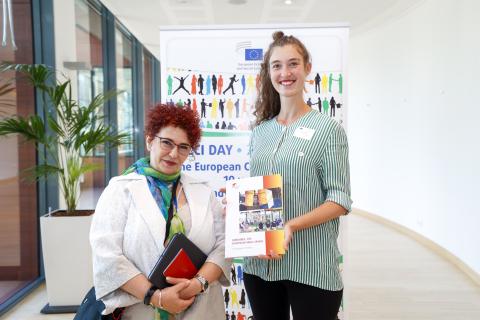
On European Citizens' Initiative (ECI) Day 2022, hosted by the EESC on 2 June, speakers and activists stressed that a more impactful ECI would also be more popular.
The EESC celebrated a decade of European Citizens' Initiatives with an event taking stock of the achievements and challenges and looking forward to the future. Speakers and activists painted a mixed picture, with some remarkable successes standing side by side with shortcomings and weaknesses, among which impact, accessibility and visibility stood out.
"We are celebrating the 10th anniversary of this still unique transnational participatory tool," said EESC president Christa Schweng as she opened the event. "Ten years is a long time: we have definitely gained some experience. But it is also very short: we still have to learn, improve and make sure the ECI gets the place it deserves in the EU institutional process."
The EESC president announced the EESC's decision to take a stance on relevant successful initiatives before the European Commission actually responds to them, starting with the Save the Bees ECI. The EESC will also pay special attention to young people and monitor how Member States are taking up the possibility of lowering to 16 the minimum age for signing an ECI – an option that has so far become a reality in one Member State, in addition to three others where the voting age in general is 16 or 17.
Commission Vice-President Dubravka Šuica stressed the link with the Conference on the Future of Europe, saying: "The ECI is an example of the institutions' ability to adapt, change and improve our engagement with citizens. Our focus must be on continuing to develop an ecosystem of democratic innovation and citizen engagement and participation in democracy."
MEP Helmut Scholz suggested that, if the European Parliament were to acquire the right of legislative initiative through treaty changes following the Conference on the Future of Europe, it could take it upon itself to make sure that successful ECIs are followed through. "Citizens are not the object, but the subject of democracy in our societies, and the subjects of democracy must have the right to decide and influence policymaking," he said.
The secret of success
One workshop zoomed in on the success of recent ECIs, such as End the Cage Age, Save the Bees and Stop Finning. Their initiators agreed that, in the absence of substantial financial resources for campaigns, whose cost they estimated at some EUR 300,000, the backing of NGOs or NGO networks was key to obtaining the required one million signatures. People trust them, they stressed, and because they trust them, they are more willing to sign and provide the personal details and information required from signatories by Member States.
The story of Stop Finning was a case in point, with a campaign that managed to collect 500,000 signatures in its last month. A snowball effect was triggered in that final push, as smaller NGOs attracted bigger ones. When a social media influencer finally joined the campaign, the ECI hit its target pretty quickly.
The ECI and the next generation
One session looked at the popularity of the ECI among young people, who rank high among initiators, though not among the most successful ones. Speakers discussed how the institutions could encourage more young people to use tools like the ECI. They said that new EU tools have to be created together with young people in order to be successful. Young activists also stressed that political education at a young age is necessary across the EU to prevent such tools from being accessible only to the highly-educated few.
In these ten years, 90 ECIs have been launched by more than 800 people, who have collected over 16 million signatures from across the EU. However, very few of these ECIs have managed to collect the required one million signatures and even fewer have obtained a positive response from the Commission, among them Ban Glyphosate. Nevertheless, some of Right2Water's requests were incorporated into the Drinking Water Directive. The most recent successful initiative, End the Cage Age, will be followed up, with specific legislation to be proposed by the European Commission in 2023. Some 20 ECIs are underway at the moment. Three are in the verification process, while 17 are currently collecting signatures across the EU and many of them did so at the event.
While some initiators, such as those of One of Us, expressed disappointment with the tool, others, like the representative of Ban Glyphosate, said they had achieved more than they could have hoped for. Making this the prevalent experience was one of the concerns running through this event.
Bruno Kaufmann, global democracy correspondent at SWI siwssinfo.ch, highlighted the wider importance of ECIs: "In these last 50 years, the European Union has changed from a remote, cautious international government to today's highly tangible, confident transnational democracy. The ECI is part of this dynamic, empowering reality. It is also an inspiration for people around the globe. By standing up for democracy at a critical point in time when democracy is coming under pressure everywhere, we have made history – and I fear, but also hope, that we will be called upon to make more history in the years to come, in the name of Europe and in the name of democracy."
Work organisation
Recommended for you
Az egészségügyi ágazatbeli közszolgáltatások közös létrehozása erősíteni fogja a demokrácia részvételi jellegét az EU-ban
News
Az Európai Gazdasági és Szociális Bizottság (EGSZB) és a Debreceni Egyetem által szervezett rendezvény rávilágított, mennyire fontos az általános érdekű szolgáltatások közös létrehozása az…
YEYS! 2023: A fiatalok átláthatóbb, digitalizált és egyszerűbb EU-t szeretnének
News
Március 23-án és 24-én az Európai Gazdasági és Szociális Bizottság (EGSZB) immár 14. alkalommal adott otthont a „Your Europe, Your Say!” (A Te Európád, a Te szavad! – YEYS!) című rendezvénynek. Erre…
Az EGSZB megnyitja a jelentkezést civil társadalmi díjára, melynek témája a mentális egészség
News
Civil társadalmi szervezetek, magánszemélyek és magánvállalkozások mostantól nevezhetik nonprofit projektjeiket az európai polgárok mentális jólétének támogatásának szentelt EGSZB-díjra. Az Európai…
Az EGSZB felhívása: 2024 júniusában szavazzunk egy egységes és demokratikus Európai Unióra!
News
A demokrácia világszerte hanyatlik, a növekvő infláció és a háború fenyegető veszélye közepette a dezinformáció térnyerése és egyre nagyobb elégedetlenség tapasztalható. Nagy tehát a tétje az új…
Az Európai Gazdasági és Szociális Bizottság készen áll arra, hogy együttműködjön az EU Tanácsának magyar elnökségével
News
Az Európai Gazdasági és Szociális Bizottság (EGSZB) júliusi plenáris ülésén Oliver Röpke EGSZB-elnök vitát tartott Bóka János európai uniós ügyekért felelős miniszterrel, aki ismertette az EU Tanácsa…