
European Economic
and Social Committee
Circular economy at the heart of Europe’s strategic autonomy
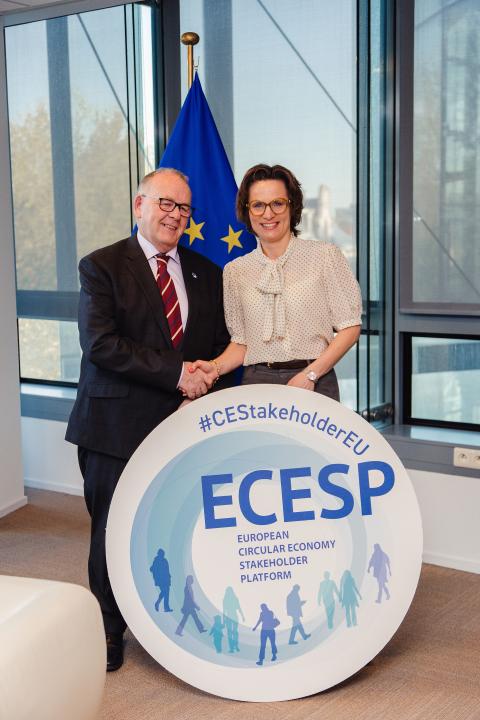
Accelerating the transition to a circular economy is not only about making Europe cleaner and more competitive, but also about achieving strategic autonomy. The European Circular Economy Stakeholders platform is set to play a crucial role in this process.
‘A competitive and fair circular Europe: The Ambition at the Heart of the Single Market”, was the motto of the annual conference organised by the European Circular Economy Stakeholder Platform, a joint initiative of the European Commission and the European Economic and Social Committee (EESC), on 22–23 April. The conference was designed to facilitate genuine two-way communication, bringing together policymakers, business leaders, financial experts, civil society representatives, youth leaders and regional stakeholders to exchange experiences, perspectives and visions. The conference also highlighted the role of organised civil society in shaping these priorities and grounding them in social, economic and territorial realities.
''In times of instability, circular economy is not a choice, it’s a necessity. Dependencies have a cost, as oil shocks keep reminding us. Circularity means reclaiming value, strengthening resilience, and building Europe’s economic autonomy'.' said Jessika Roswall, Commissioner for Environment, Water Resilience and a Competitive Circular Economy.
This was another opportunity to engage the social partners in the work on the EESC opinion currently being drafted under the title 'Circular Economy Act: The Circular Economy and Responsible Resource Consumption within Planetary Boundaries'. It will inform the Circular Economy Act to be proposed by the European Commission in Q3 of this year. The Act aims to contribute to establishing a single market for secondary raw materials, increase the supply of high-quality recycled materials, and stimulate demand for them within the EU.
“The strong cooperation between the European Commission and the European Economic and Social Committee is at the heart of this platform. It reflects a shared conviction: that Europe’s transition to a circular economy cannot be delivered by institutions alone. It must be shaped, challenged and owned by those who make our economy work every day.“, said Séamus Boland, EESC President.
Europe, as highlighted during the conference, is currently facing a period of profound change, during which accelerating the circular transition is urgently needed. The EU is under pressure from multiple fronts, including the triple planetary crisis of climate emergency, biodiversity loss and pollution, as well as geopolitical uncertainty, rapid technological transformation and legitimate concerns about competitiveness and social cohesion. “A sense of urgency is fundamental; we cannot afford to wait. The Circular Economy Act is part of the European Union's strategic autonomy. Without an effective circular economy, we will be more dependent on others,” stressed Enrico Letta, author of the “Report on the Future of the Single Market” and the President of the Jacques Delors Institute. The EU relies heavily on imported raw materials for key sectors such as renewable energy, digital, mobility, aerospace and defence. A circular economy could mitigate this critical dependency by, for example, recycling materials or remanufacturing products locally. Letta’s report, alongside Mario Draghi’s, is guiding the European Commission in its work to complete the single market.
Recent evidence highlights the urgent need for action. According to the European Environment Agency, Europe’s circularity rate was 11.8% in 2023, which is higher than in other world regions but shows limited progress in recent years. Accelerating the transition to a circular economy is therefore a clear policy priority. As part of its Clean Industrial Deal, the European Commission has set the ambitious target of doubling this rate to around 24% by 2030, highlighting circularity as a key driver of competitiveness, resilience, and reduced resource dependency. “We are now at a pivotal moment. Everyone understands the importance of the circular economy. The question is how to bring things together and scale them up,” admitted said Maria Nikolopoulou, EESC Sustainable Development Observatory President.
One of the topics raised during the conference was the synergy between the circular economy and the bioeconomy, with the aim of better transforming waste into valuable products while supporting food security and securing renewable biomass supplies, thereby fostering a competitive and sustainable EU economy. “The bioeconomy remains largely linear, while the circular economy is not just about recycling, it is a strategic way of thinking about value, resources and resilience. As Enrico Letta reminds us, the urgency is real: Europe must rethink how it produces, uses and reuses if it wants to reach the strategic autonomy we all wish”, said Stoyan Tchoukanov, President of the EESC Section for Agriculture, Rural Development and the Environment.
Work organisation
Recommended for you
Az egészségügyi ágazatbeli közszolgáltatások közös létrehozása erősíteni fogja a demokrácia részvételi jellegét az EU-ban
News
Az Európai Gazdasági és Szociális Bizottság (EGSZB) és a Debreceni Egyetem által szervezett rendezvény rávilágított, mennyire fontos az általános érdekű szolgáltatások közös létrehozása az…
YEYS! 2023: A fiatalok átláthatóbb, digitalizált és egyszerűbb EU-t szeretnének
News
Március 23-án és 24-én az Európai Gazdasági és Szociális Bizottság (EGSZB) immár 14. alkalommal adott otthont a „Your Europe, Your Say!” (A Te Európád, a Te szavad! – YEYS!) című rendezvénynek. Erre…
Az EGSZB megnyitja a jelentkezést civil társadalmi díjára, melynek témája a mentális egészség
News
Civil társadalmi szervezetek, magánszemélyek és magánvállalkozások mostantól nevezhetik nonprofit projektjeiket az európai polgárok mentális jólétének támogatásának szentelt EGSZB-díjra. Az Európai…
Az EGSZB felhívása: 2024 júniusában szavazzunk egy egységes és demokratikus Európai Unióra!
News
A demokrácia világszerte hanyatlik, a növekvő infláció és a háború fenyegető veszélye közepette a dezinformáció térnyerése és egyre nagyobb elégedetlenség tapasztalható. Nagy tehát a tétje az új…
Az Európai Gazdasági és Szociális Bizottság készen áll arra, hogy együttműködjön az EU Tanácsának magyar elnökségével
News
Az Európai Gazdasági és Szociális Bizottság (EGSZB) júliusi plenáris ülésén Oliver Röpke EGSZB-elnök vitát tartott Bóka János európai uniós ügyekért felelős miniszterrel, aki ismertette az EU Tanácsa…