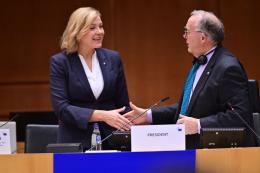
President of the European Economic and Social Committee (EESC) Séamus Boland met European Council President António Costa in Dublin today ahead of the European Council to set out organised civil society’s priorities for the development of a people-centred artificial intelligence.
Lors d’une conférence de haut niveau organisée conjointement avec Eurofound, le CESE a mis en avant la nécessité de trouver des solutions coordonnées aux problèmes de logement en Europe, qui sont devenus l’un des défis sociaux et économiques les plus pressants d’aujourd’hui.
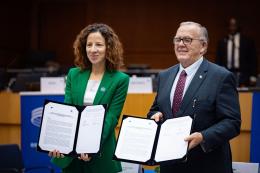
The European Economic and Social Committee (EESC) and the European Commission signed a Memorandum of Understanding to strengthen their cooperation in the fight against poverty and social exclusion. EESC President Séamus Boland, EU policymakers, civil society representatives, social partners and people with lived experience of poverty discussed how Europe can accelerate progress towards eradicating poverty by 2050 at a debate hosted by the EESC.
Lors de sa session plénière d’octobre, le CESE a tenu un débat sur la souveraineté technologique de l’Europe, au cours duquel il a été souligné que le progrès technologique doit aller de pair avec des emplois de meilleure qualité et de meilleures conditions de travail.
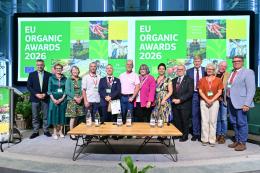
The 2026 EU Organic Awards have once again rewarded outstanding, innovative and sustainable projects across Europe’s organic value chain. The winners offer a tangible example of the social farming model promoted by the European Economic and Social Committee: farms that create jobs, enable workers to reach their potential and help rural communities thrive. In a newly adopted opinion, the EESC urges the European Commission and Member States to give such initiatives long-term support.
Lors de la session plénière de septembre du Comité économique et social européen (CESE), ce dernier et le Conseil économique, social et environnemental français ont réaffirmé leur volonté d’œuvrer en partenariat à défendre résolument le rôle et le modèle de démocratie participative qu’ils incarnent, avec pour but ultime de contribuer à bâtir un avenir meilleur pour les Européens.
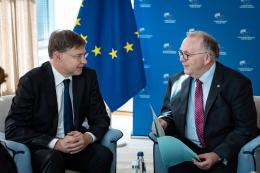
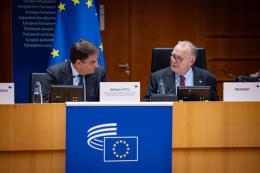
At a high-level debate with European Commissioner Valdis Dombrovskis on 23 September, the European Economic and Social Committee (EESC) backed simpler EU rules but called for stronger evidence, clearer safeguards and greater democratic scrutiny of the Commission’s better regulation plans.
Rural areas are essential to Europe’s prosperity and resilience, yet many people living there have poorer access to services, jobs and infrastructure. In an opinion adopted at its September plenary, the European Economic and Social Committee calls for a practical, EU-wide ‘rural proofing’ tool to ensure that policymakers assess the impact of decisions on rural communities from the outset. This approach should also shape the next EU budget and National and Regional Partnership Plans.
The European Economic and Social Committee (EESC) has welcomed the winners of the 2026 edition of the EU Organic Awards, celebrating three outstanding businesses that are helping make organic food more accessible, innovative and sustainable across Europe.
The winners were announced in Brussels on EU Organic Day, 23 September, during the official EU Organic Awards ceremony.
More than 50 high-level experts from across the EU water sector gather in Brussels on 21 September for the first meeting of the Water Resilience Stakeholder Platform, launched by the European Commission together with the European Economic and Social Committee and the European Committee of the Regions. The European Water Academy will hold its inaugural meeting in the afternoon.