
European Economic
and Social Committee
Better regulation does not mean deregulation
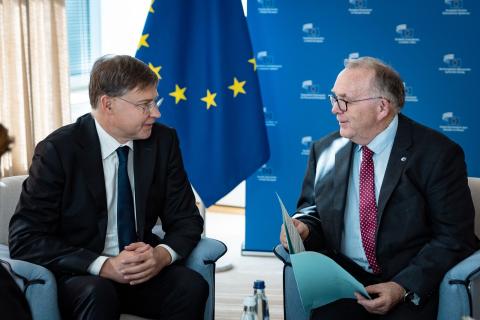
At a high-level debate with European Commissioner Valdis Dombrovskis on 23 September, the European Economic and Social Committee (EESC) backed simpler EU rules but called for stronger evidence, clearer safeguards and greater democratic scrutiny of the Commission’s better regulation plans.
The EESC agrees that the EU should make its rules clearer and easier to apply, but insists that simplification ‘must not weaken social, environmental or consumer protections’, it said during its plenary debate with Commissioner Dombrovskis, President of the Czech Chamber of Commerce, Zdeněk Zajíček, Confederal Secretary of the European Trade Union Confederation (ETUC), Ludovic Voet, and Director for Enterprise Policy and Legal Affairs at SMEunited, Sophia Zakari.
The Commission wants EU laws to be ‘simple by design’ and has proposed changes to impact assessments, public consultations and the review of existing legislation. Despite welcoming that ambition, the EESC says the proposals do not yet show clearly enough how simplification will affect businesses, workers, citizens or the environment.
‘Simpler rules must still be strong rules. Better regulation is not deregulation. It means regulation that is clear, proportionate and effective. Rules must work in the real world. For SMEs, workers, consumers and public authorities, clarity and consistent enforcement are essential to trust and to a well-functioning Single Market’, EESC president Séamus Boland said.
Commissioner Dombrovskis has invited the EESC to nominate its three representatives to the high-level stakeholder group – the Simplification Platform – which will support simplification efforts.
‘Better rules require better dialogue. Evidence from social partners and civil society must shape legislation from the beginning. Our goal is simple: rules that are easier to understand, easier to apply and better able to deliver. The EESC is ready to bring that evidence to the Commission and the Simplification Platform’, President Boland said.
‘The EESC’s mission to help ensure that EU policies and legislation respond to the real economic, social and civic conditions on the ground is very much in line with our focus on simplification and better regulation. Working together on this agenda will be crucial to achieving what I believe to be our shared objective of securing Europe’s long-term welfare, prosperity and security’, Commissioner Dombrovskis said.
In his address to the EESC plenary, Commissioner Dombrovskis said the Commission’s simplification proposals and initiatives, such as Omnibuses, have the potential to save at least EUR 17 billion in annual administrative costs for European businesses and national administrations. Those savings can be redirected from compliance towards investment and innovation.
The Commission’s simplification efforts will continue through the entire mandate. ‘That is the only way we can turn an ambitious agenda into the real, tangible results our citizens and businesses deserve’, the Commissioner announced.
THE RULEBOOK GAPS
In its opinion on better regulation, adopted following the plenary debate, the EESC identified several weaknesses in the Commission’s revamped rulebook.
The opinion says the Commission still lacks a comprehensive picture of the cumulative costs and benefits of EU legislation, making it harder to spot burdens, overlaps and gaps, particularly for SMEs. It also warns that the new ‘matrix of key impacts’ is too vaguely defined and must not allow proposals labelled ‘targeted’ or ‘urgent’ to escape full impact assessment and independent scrutiny.
Rapporteur of the opinion, Katrīna Zariņa, said: ‘Europe needs simpler rules to strengthen its competitiveness, but simplification must not become deregulation. As President von der Leyen stressed in her State of the Union address, simplification cannot be a one-way street. Better regulation is a shared responsibility – of the Commission, Parliament and Council, but also of Member States when EU rules are implemented and enforced’.
The EESC asked the Commission to distinguish unnecessary national additions to EU rules, known as ‘gold-plating’, from legitimate decisions to maintain higher social or fundamental-rights protections.
It called for verifiable measures of the short- and long-term impact of regulation and simplification, a mandatory summary of business obligations in every proposal, and binding application of the ‘think small first’ principle.
Proposals should be developed with the smallest businesses in mind. Exemptions for SMEs, however, should be considered only where they would not harm market access, workers’ rights or social and environmental protections.
The EESC rejects plans to cut public consultations from twelve to six weeks. It also called for stronger scrutiny of delegated and implementing acts, and urged Parliament and Council to assess the effects of substantial amendments, including changes agreed in final negotiations. It also wants the effects of broad ‘omnibus’ packages to be evaluated against the final adopted legislation, as well as the original proposal.
‘We need greater regulatory discipline throughout the legislative process, cutting unnecessary complexity and gold-plating, while ensuring that economic, social and environmental impacts are properly considered. Ultimately, better regulation is about making Europe’s rules simpler, more proportionate and more effective – so that Europe can deliver on its ambitions in a rapidly changing world’, Ms Zarina stressed.
ADDITIONAL QUOTES:
Sandra Parthie, President of EESC’s Employers’ Group: ‘Europe does not need more rules, it needs rules that work. With 64% of SMEs identifying administrative burden as main problem, simplification becomes a necessity. But let’s be clear: it does not mean deregulation, it means making rules simpler, proportionate, and enforceable’.
Lucie Studnična, President of EESC’s Workers’ Group: ‘The number of rules alone cannot determine whether regulation is good or bad. A rule is not simply a cost. Regulation provides legal certainty, protects workers, prevents unfair competition and creates a level playing field’.
Arnaud Schwartz, Vice-President of the EESC’s Sustainable Development Observatory and member of its Civil Society Organisations’ Group: ‘Better Regulation must defend rules that protect our health, jobs and environment, and should deliver meaningful and consistent civic participation, assess the costs of EU inaction, and avoid derogations and deregulation. The Commission must uphold its own rules consistently and reject shortcuts that weaken evidence-based policymaking and democratic accountability’.
Work organisation
Recommended for you
From Recommendations to Results: Is administrative capacity becoming the missing link in the European Semester?
Event
The Section for Economic and Monetary Union and Economic and Social Cohesion (ECO) of the European Economic and Social Committee (EESC) is finalising an opinion on the 2026 European Semester –…
Financing of the EU Budget and the role of an EU safe asset
Event
Public debate in the ECO Section on the Financing of the EU Budget and the role of an EU safe asset.The event will be webstreamed and open to all interested stakeholders. No registration is needed…
The Multiannual Financial Framework after 2027: assessing progress and outstanding challenges
Opinion
Practical information:Composition of the study groupAdministrator in charge: Gerald KLEC / Assistant: Elzbieta CIOLEKContact: E-mail_________________The EU’s next budget:…
Competitiveness beyond growth: building a sustainable and resilient European economy
Event
EVENT POSTPONED to 2027Europe’s competitiveness challenge cannot be reduced to a race for lower costs or deregulation but must instead be built on the strengths of Europe's unique social market…
Tax rules as code (TRACK) for EU tax directives: Enhancing legal clarity, cross-border comparability and democratic governance through artificial intelligence
Event
The European Economic and Social Committee (EESC) invites you to attend our public hearing on how using artificial intelligence and digitalisation in tax administration can strengthen legal clarity,…