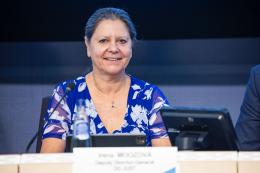
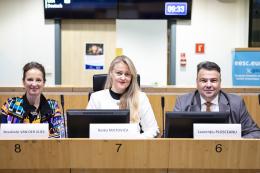
At its June plenary session, the European Economic and Social Committee (EESC) became the first EU body to formally endorse the Declaration of principles for a gender-equal society, backing the European Commission’s Roadmap for Women’s Rights. This move sends a clear signal that urgent, concrete action is needed to close persistent gender gaps.
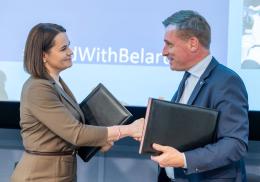
Par la signature d’un protocole d’accord avec les forces démocratiques biélorussiennes, représentées par Mme Sviatlana Tsikhanowskaïa, le Comité économique et social européen (CESE) réaffirme son soutien sans faille à une Biélorussie démocratique. Ce nouveau protocole formalise une nouvelle phase de collaboration structurée ayant pour visée d’appuyer la société civile biélorussienne et ses aspirations européennes.
Following a debate in plenary with European Executive Vice-President Roxana Mînzatu, the European Economic and Social Committee adopted an own-initiative opinion urging the European Commission to deliver a more ambitious and fairer action plan for the implementation of the European Pillar of Social Rights.
La conférence sur le caractère abordable de l’énergie, organisée conjointement par le Comité économique et social européen (CESE) et la Commission européenne, a souligné la nécessité d’une participation active du plus grand nombre possible de citoyens. Les ménages, les citoyens vulnérables et les PME doivent devenir les principaux acteurs de la transition énergétique, y compris dans les zones rurales.
Lors de la réunion extraordinaire du bureau du Comité économique et social européen (CESE) qui s’est tenue à Copenhague le 19 mai, les participants ont souligné l’importance des compétences, de l’éducation et de l’apprentissage tout au long de la vie pour mener à bien les transitions verte et numérique de l’UE.
The European Economic and Social Committee (EESC) launched its 10th Western Balkans Civil Society Forum today in Budva, Montenegro, gathering over 100 participantsto discuss how to accelerate socio-economic convergence with the EU for improved living standards across the region. The two-day Forum, 13-14 May is taking place in Budva, Montenegro, to support Montenegro's ambition to become the next EU Member State by 2028 and to serve as a model for the rest of the region.
L’Europe doit s’efforcer d’investir dans sa défense et sa sécurité, tout en préservant son modèle social. Des compromis financiers seront peut-être nécessaires en raison des défis géopolitiques qui nous obligent à repenser les priorités européennes. Le Comité économique et social européen (CESE) peut faciliter un dialogue social honnête sur les nouveaux besoins de l’UE.
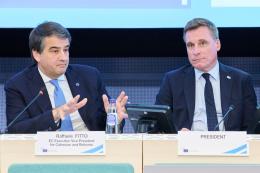
The European Economic and Social Committee (EESC) has adopted an opinion on the European Commission’s mid-term review of cohesion policy 2021–2027, urging the EU to adapt to evolving priorities while staying true to the policy’s founding aim: to reduce regional disparities. During a plenary debate with Commission Vice-President Raffaele Fitto, the EESC called for greater flexibility, more effective funding tools, fair access for all regions and a more robust EU budget to support long-term investment.
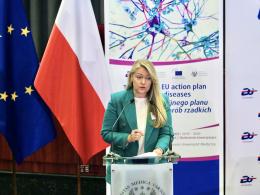
Une conférence de haut niveau organisée à Varsovie sous les auspices de la présidence polonaise du Conseil de l’Union européenne a souligné l’importance d’adopter un cadre global pour une action publique à l’échelle européenne en matière de maladies rares.
The European Economic and Social Committee (EESC), the European Training Foundation (ETF), and Eurofound are joining forces on 3 April in Tirana for a high-level event focused on promoting effective social dialogue and collaboration in the Western Balkans. Titled Enhancing quality of work and life through effective social dialogue in the Western Balkans, the by-invitation-only event will bring together key stakeholders to explore challenges and opportunities in the region’s labour markets and social policies.