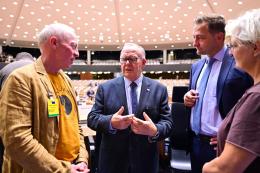
The 2026 EU Organic Awards have once again rewarded outstanding, innovative and sustainable projects across Europe’s organic value chain. The winners offer a tangible example of the social farming model promoted by the European Economic and Social Committee: farms that create jobs, enable workers to reach their potential and help rural communities thrive. In a newly adopted opinion, the EESC urges the European Commission and Member States to give such initiatives long-term support.
Lors de la session plénière de septembre du Comité économique et social européen (CESE), ce dernier et le Conseil économique, social et environnemental français ont réaffirmé leur volonté d’œuvrer en partenariat à défendre résolument le rôle et le modèle de démocratie participative qu’ils incarnent, avec pour but ultime de contribuer à bâtir un avenir meilleur pour les Européens.
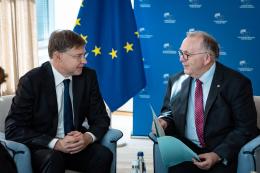
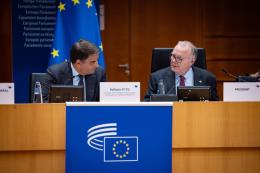
At a high-level debate with European Commissioner Valdis Dombrovskis on 23 September, the European Economic and Social Committee (EESC) backed simpler EU rules but called for stronger evidence, clearer safeguards and greater democratic scrutiny of the Commission’s better regulation plans.
Rural areas are essential to Europe’s prosperity and resilience, yet many people living there have poorer access to services, jobs and infrastructure. In an opinion adopted at its September plenary, the European Economic and Social Committee calls for a practical, EU-wide ‘rural proofing’ tool to ensure that policymakers assess the impact of decisions on rural communities from the outset. This approach should also shape the next EU budget and National and Regional Partnership Plans.
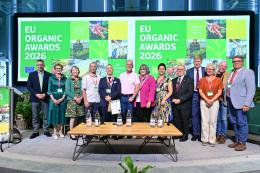
The European Economic and Social Committee (EESC) has welcomed the winners of the 2026 edition of the EU Organic Awards, celebrating three outstanding businesses that are helping make organic food more accessible, innovative and sustainable across Europe.
The winners were announced in Brussels on EU Organic Day, 23 September, during the official EU Organic Awards ceremony.
More than 50 high-level experts from across the EU water sector gather in Brussels on 21 September for the first meeting of the Water Resilience Stakeholder Platform, launched by the European Commission together with the European Economic and Social Committee and the European Committee of the Regions. The European Water Academy will hold its inaugural meeting in the afternoon.
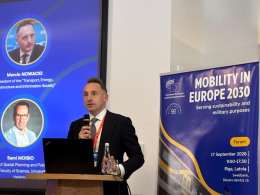
Lors d’une manifestation de haut niveau organisée à Riga en coopération avec l’association lettone «Sustainability Cluster», le Comité économique et social européen (CESE) a souligné la nécessité de réaliser des progrès substantiels dans la concrétisation de la vision de l’UE pour un système de mobilité amélioré.
Water resilience requires stronger cooperation, recognition of access to affordable water as a universal right, and a more effective multilateral framework. The EESC brought together civil society actors to help shape the EU contribution to the 2026 UN Water Conference.
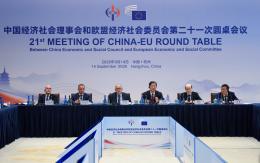
The European Economic and Social Committee (EESC) called for a balanced, forward-looking and people-centred approach to EU-China relations, stressing the need to address growing trade imbalances, strengthen efforts to combat poverty, promote trustworthy and human-centred artificial intelligence, and maintain an open dialogue on human rights.
On Tuesday 8 September 2026, European Economic and Social Committee (EESC) President Séamus Boland welcomed European Commissioner for Enlargement Marta Kos to his family farm in Ballycumber, County Offaly, for discussions on EU enlargement and the essential role of civil society in preparing candidate countries for membership. The meeting took place during Commissioner Kos's visit to Ireland for the EU Council Presidency meetings of foreign affairs and European affairs ministers in Wicklow and Dublin.