
European Economic
and Social Committee
European Economic and Social Committee champions sodium batteries for Europe’s industrial and energy future
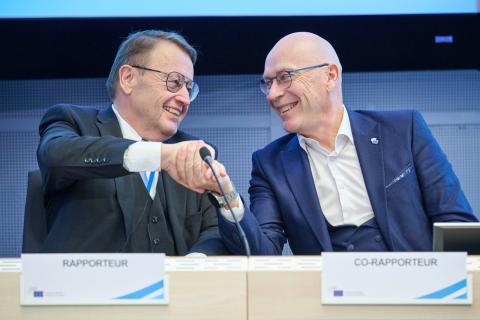
The European Economic and Social Committee (EESC) considers sodium batteries a strategically important technology for Europe and calls for them to become a key element of the EU’s industrial strategy, as highlighted during the Committee’s plenary session debate on the potential of these batteries, held on 19 February, and in its latest adopted opinion.
EESC President Séamus Boland announced that the Committee is placing sodium batteries firmly at the centre of its work on the EU industrial and energy agenda. ’Sodium batteries, and batteries more broadly, are key for the EU’s competitive edge, and it is urgent that the next Multi-Annual Financial Framework recognises this by providing the necessary funds for the sector,’ he said.
‘We thank the EESC for choosing sodium batteries as the topic for this debate. This technology is abundant, affordable and ideal for a circular value chain. This opinion is very timely and will help set the right level of ambition for Europe,’ said Marc Lemaître, Director-General of the European Commission’s DG Research and Innovation.
‘China is currently the global leader in battery technology, with EUR 1.2 billion invested in R&I over the past ten years. This has given it a strong position in intellectual property and increased production capacity. Our journey has just started. We need to build on our existing strengths, ensure that innovation is translated into production and reinforce what works with strategic support,’ added Fabrice Stassin, Secretary-General of the Batteries European Partnership Association (BEPA) stressing the urgency of action for Europe.
A strategic opportunity for European industry
The EU has already launched large-scale gigafactory projects to produce batteries at high volumes in order to reindustrialise Europe and strengthen its strategic autonomy. However, these projects focus mainly on lithium batteries and largely neglect the emerging technology of their sodium equivalents.
Participants in the debate underlined that sodium batteries, particularly in sodium-saltwater systems, could position Europe as a global leader. Produced from abundant and widely available raw materials in Europe, sodium batteries can reduce dependence on critical imports, support EU climate and industrial objectives and create jobs through the development of gigafactories across the value chain.
Unlike lithium, sodium does not expose the EU to the same geopolitical dependencies or supply chain vulnerabilities. It is inexpensive, accessible and present throughout the continent.
The debate also highlighted the strong links between sodium batteries and both the EU’s Green Deal and the EESC’s EU Blue Deal initiative. ’The EESC put water on the agenda because, in emergency preparedness, water, energy and food are the real raw material emergencies. The vast majority of the Earth’s water is salt water. By using the sodium from desalination processes, we can turn a largely untapped resource into a sustainable, circular industrial solution,’ said Paul Rübig, EESC rapporteur for the opinion on Enhancing EU strategic autonomy and developing a greener and bluer economy: the potential of the sodium battery manufacturing sector.
Call for coordinated EU action
Europe must act quickly to avoid falling behind its global competitors, which are already advancing on sodium battery technology. ‘Either we remain mere consumers, or we propose an ambitious plan for the next ten years and become one of the largest suppliers of sodium-based batteries. All European countries can participate in the construction process and benefit from a technology that promotes our independence while creating jobs in all regions,’ said Hervé Jeannin, co-rapporteur for the opinion.
The EESC opinion on sodium batteries presents an overview of the current situation and the development potential of this emerging industry, which provides a less costly, environmentally friendly alternative to the lithium batteries. It also showcases the potential applications of such batteries in different sectors (e.g. by industry, local and regional authorities, and private households) and sets out the way forward for the industry.
The Committee stresses the need to update the industrial pathway for batteries so as to cover both lithium and sodium technologies, invest in skills and SMEs, align major EU strategies and provide flexible public support mechanisms, ranging from subsidies and tax incentives to joint public-private R&D. It also points out the potential for converting unused industrial sites into gigafactories and stresses the importance of eco-design and recycling in establishing a circular sodium battery value chain.
A new focus for the EESC’s industrial work
’For us, it is very clear that the adoption of this opinion is not the end of the journey, but only the beginning. We have outlined an initial pathway forward, but developing a competitive sodium battery industry in Europe will require political will, coordinated action and strong investment.’ said Alain Coheur, president of the EESC’s Consultative Commission on Industrial Change (CCMI).
This debate set the stage for a broader EESC focus on sodium batteries, with upcoming opinions, stakeholder debates and a dedicated study aimed at placing sodium batteries firmly on Europe’s industrial agenda and supporting a more resilient, competitive and sustainable economy.
Recommended for you
Az egészségügyi ágazatbeli közszolgáltatások közös létrehozása erősíteni fogja a demokrácia részvételi jellegét az EU-ban
News
Az Európai Gazdasági és Szociális Bizottság (EGSZB) és a Debreceni Egyetem által szervezett rendezvény rávilágított, mennyire fontos az általános érdekű szolgáltatások közös létrehozása az…
YEYS! 2023: A fiatalok átláthatóbb, digitalizált és egyszerűbb EU-t szeretnének
News
Március 23-án és 24-én az Európai Gazdasági és Szociális Bizottság (EGSZB) immár 14. alkalommal adott otthont a „Your Europe, Your Say!” (A Te Európád, a Te szavad! – YEYS!) című rendezvénynek. Erre…
Az EGSZB megnyitja a jelentkezést civil társadalmi díjára, melynek témája a mentális egészség
News
Civil társadalmi szervezetek, magánszemélyek és magánvállalkozások mostantól nevezhetik nonprofit projektjeiket az európai polgárok mentális jólétének támogatásának szentelt EGSZB-díjra. Az Európai…
Az EGSZB felhívása: 2024 júniusában szavazzunk egy egységes és demokratikus Európai Unióra!
News
A demokrácia világszerte hanyatlik, a növekvő infláció és a háború fenyegető veszélye közepette a dezinformáció térnyerése és egyre nagyobb elégedetlenség tapasztalható. Nagy tehát a tétje az új…
Az Európai Gazdasági és Szociális Bizottság készen áll arra, hogy együttműködjön az EU Tanácsának magyar elnökségével
News
Az Európai Gazdasági és Szociális Bizottság (EGSZB) júliusi plenáris ülésén Oliver Röpke EGSZB-elnök vitát tartott Bóka János európai uniós ügyekért felelős miniszterrel, aki ismertette az EU Tanácsa…