
European Economic
and Social Committee
One Europe, One Market: from strategy to delivery - EESC, CoR and EP discuss the EU's new roadmap for a truly unified market
Insufficient enforcement of common EU rules, threats to consumer confidence, excessive complexity for SMEs and a loss of competitiveness in the digital sector are among the greatest challenges facing the Single Market. The EU has a duty to protect it in order to promote economic growth and maintain social cohesion.
On 3 June, the European Economic and Social Committee (EESC), the Committee of the Regions (CoR) and the European Parliament (EP) jointly organised a conference entitled 'One Europe, One Market: From Strategy to Delivery'. The event focused on how to turn the EU’s new “One Europe, One Market” roadmap, launched by EU leaders in April, into concrete results for citizens and businesses.
The conference brought together EESC and CoR members, MEPs, civil society stakeholders and experts, to discuss the future of Europe's Single Market which, despite being one of the pillars of European integration, remains heavily fragmented, hampering Europe's competitiveness and economic growth.
'The Single Market is under pressure. Fragmentation persists across sectors. Enforcement gaps undermine fairness. SMEs struggle with complexity and uneven implementation. Consumers face uncertainty about product safety and compliance. We at the EESC hear these concerns directly from businesses, workers and civil society — the very people who should benefit fully from the single market, but still do not. We truly believe that the single market is fundamentally about people,' said Antje Gerstein, President of the Single Market, Production and Consumption Section of the EESC.
Despite the fact that the EU's Single Market originated from a vision of European integration, its development and reform cannot now be based solely on debates about high-level political ideas. This is because businesses and citizens require concrete solutions to very specific obstacles.
'There is no magic law that you implement and then the Single Market is created. It is much more difficult and much more nitty-gritty. So we also have to hear from businesses and consumers, and take concrete examples of where things are not functioning,' said Anna Cavazzini, Chair of the EP's IMCO Committee.
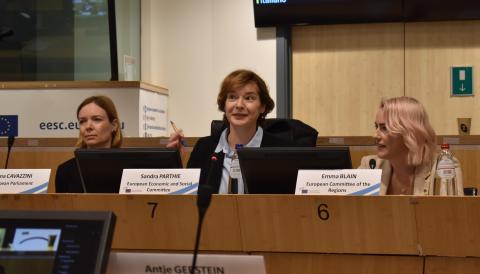
Emma Blain, a Dublin City Councillor and member of the European Committee of the Regions, emphasised that the EU’s current efforts to strengthen the competitiveness of the Single Market must go hand in hand with preserving the regional dimension of European integration.
“We strongly support efforts to deepen the Single Market and strengthen Europe's competitiveness. At the same time, in the context of the next Multiannual Financial Framework and future EU funding programmes, it should be recognised that cohesion policy and the Single Market are not competing priorities; rather, they are mutually reinforcing. One cannot succeed sustainably without the other”, urged Ms Blain.
UNSAFE PRODUCTS INUNDATE EUROPE'S ONLINE MARKETS
The main theme of the panel discussion, 'Product safety and compliance: enhancing market surveillance for better products and consumer protection', was how online marketplaces have become a significant source of unsafe or non-compliant products entering the market, mostly originating from China.
The current liability regime does not reflect the realities of digital commerce, as emphasised by the panellists, thereby eroding consumer confidence in the safety of products sold online in the EU. In 2024 alone, through consumer purchase of such products, financial losses amounted to two billion euros, which could have been invested in European products and companies.
MEP Dirk Gotink stressed that, to restore consumer confidence and ensure fairness for EU businesses, the EU must enforce its standards on companies from outside the EU, as well as on EU manufacturers and retailers – something it does well. 'We need to restore a level playing field. Just like in the Olympics, we cannot allow clean athletes and those on steroids to compete against each other in the same event. We need to keep the market clean for companies that abide by the same set of rules,' he argued.
PUBLIC PROCUREMENT – MOVING THE FOCUS AWAY FROM THE LOWEST PRICE
The panel discussion on 'Public Procurement, Sustainability and Circular Economy Goals' highlighted the need for simpler, faster and more accessible procurement rules to reduce administrative complexity and support cross-border opportunities. This does not necessarily mean only new EU legislation, but also support from public authorities to SMEs for complying with existing rules.
One of the questions raised was how to link the public market with social policy and sustainability. 'Public procurement should also favour enterprises that adhere to the regulations governing fair labour practices and collective bargaining,' said Angelo Pagliara, EESC member and rapporteur for the EESC opinion on the Single Market Strategy.
Another problem flagged was that the current procedures were complex and price driven, which deters small operators from participating in tenders or excludes citizen-led projects on the grounds of insufficient experience.
'SMEs would benefit from not having that much focus on the lowest price. Focus on sustainability is not only environmental but also social. Public procurement must serve the objective of prioritising quality jobs and even collective bargaining. Where there is social dumping, money is not spent wisely,' said MEP Hanna Guedin.
DIGITAL MARKETS – TO REGULATE OR NOT
During the panel debate, 'Building a Smarter and Simpler Single Market for the Digital Era', the need for SMEs to have predictable rules, interoperable systems and practical support in order to comply with EU requirements was reiterated.
During this panel discussion, it was clearly stressed that the digital Single Market remains incomplete. Too many businesses still face barriers related to incompatible national systems, fragmented data rules, and insufficient interoperability between public administrations. Whether more or less regulation was needed, however, was a much debated point.
'The fragmentation of the digital single market is caused by the lack of the correct legal framework. And digitalisation has become a fundamental part of the modern economy that we can't do without. However, it should not add complexity. We need to simplify things first and then digitalise. Otherwise, we will simply be digitalising existing complexities,' warned Lorenzo Galligani, Councillor of Pistoia and rapporteur of the CoR opinion on the Single Market Strategy.
Lorenzo Reppetti, director of policy at ETUC, stressed the need to invest more in the IT and AI sectors, without weakening the existing labour and safety standards: 'In order to have a strong Single Market that works for people and companies alike, we need more investment and fairness. Simplification should not become deregulation.'
'One Europe, One Market', agreed by the EU institutions in April 2026, is a roadmap of political and operational commitments to be achieved by the end of 2027. It includes targets for legislative proposals and agreements by the co-legislators, as well as quarterly reviews to monitor progress, clear institutional responsibilities for all EU institutions in line with their prerogatives, and regular stocktaking for full transparency. The aim is to reinforce Europe’s competitiveness, resilience and long-term prosperity within the framework of a truly integrated Single Market and a stronger, more cohesive EU.