Cette étude analyse les politiques de l’Union européenne (UE) sous l’angle de la pauvreté intergénérationnelle, en recentrant l’attention sur la persistance à long terme et la transmission des désavantages entre les générations, plutôt que de considérer la pauvreté en tant que condition statique.
Le présent avis analyse la proposition de recommandation du Conseil sur l’exclusion en matière de logement présentée par la Commission et examine la question du sans-abrisme chez les enfants, les familles et les jeunes dans l’UE. Il aborde la question de l’accès à un logement digne du point de vue des droits de l’homme et recommande que la prévention et la réduction du sans-abrisme restent au cœur de la recommandation du Conseil, conformément à la déclaration de Lisbonne. Il souligne qu’une approche préventive devrait être complétée par des services sociaux d’urgence solides et recommande à tous les États membres d’élaborer un cadre stratégique pour lutter contre le sans-abrisme.
Download format:
Download — Avis de section du CESE: Lutter contre l’exclusion en matière de logement et le sans-abrisme des enfants, des familles et des jeunes
Le présent avis analyse la communication de la Commission intitulée "Briser le cycle de la pauvreté infantile - renforcer la garantie européenne pour l'enfance". Elle porte sur le renforcement de la garantie européenne pour l’enfance en tant qu’instrument axé sur l’enfant et fondé sur les droits afin de briser les cycles intergénérationnels de pauvreté et d’exclusion sociale. Il recommande de renforcer l’accès à un emploi parental de qualité et à des services d’éducation et d’accueil de la petite enfance abordables et de qualité, tout en veillant à ce que les groupes vulnérables ne soient pas exclus des services essentiels.
Download format:
Download — Avis de section du CESE: Renforcer la garantie pour l’enfance
Europe is facing a pivotal moment. Social and economic inequalities, rapid technological change, anti-democratic forces and geopolitical instability are straining the foundations of the European project.
With democracy and civic space under mounting pressure, civil society organisations, human rights defenders and free media face growing constraints - from restrictive laws and disinformation campaigns to underfunding and public distrust. Deepening polarisation and eroding trust in institutions further undermine Europe’s democratic model.
L'avis examine l’Agenda du consommateur 2030, une nouvelle stratégie quinquennale pour la politique de l’UE en matière de protection des consommateurs. L’agenda s’articule autour de quatre grands domaines prioritaires: a) un plan d’action pour les consommateurs dans le marché unique; b) l’équité numérique et la protection des consommateurs en ligne; c) une consommation durable; d) une application effective des règles et des voies de recours efficaces.
The topic of the conference was the mental and physical condition of young Europeans and the role of civil society organisations in supporting it. The event was organised as part of the Polish presidency of the EU Council on the initiative of the Minister for Civil Society, Adriana Porowska, and the Civil Society Organisations' Group of the EESC.
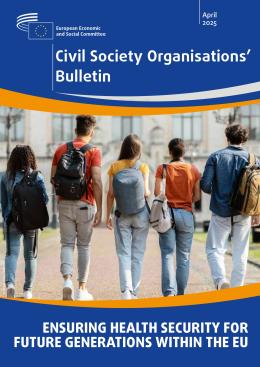
Ensuring health security for future generations within the EU
In this issue:
Members on ways to ensure (mental) health security
Guest articles by Lejla Šehić Relić (Centre for European Volunteering), Ian Mostert (Dutch Institute for Nature Education) and Christelle Savall (Young European Federalists)
Interview with rapporteur Miguel Ángel Cabra de Luna on how to address loneliness (EESC opinion SOC/813)
Joint Conference of the Minister for Civil Society of the Republic of Poland and the EESC Civil Society Organisations' Group
Event type
Conference
Location
Chancellery of the Prime Minister
Warsaw
Poland
The conference was held on 15 May 2025 at the Chancellery of the Prime Minister in Warsaw, Al. Ujazdowskie 1/3, as part of the Polish Presidency of the Council of the EU.