
European Economic
and Social Committee
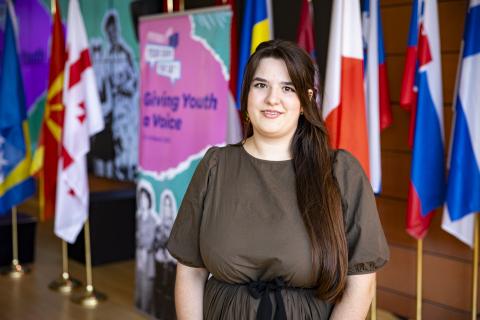
By Kristýna Bulvasová
In a precarious world where long-standing beliefs are crumbling, and previously shared values no longer unite but divide us, young people must be given opportunities to engage meaningfully here and now to address the many pressing issues that continue to grow before our eyes. The YEYS 2025 discussions clearly showed that there is no one topic that can be called the 'youth topic' and that young people are rightfully concerned about many different problems – ranging from fighting corruption and promoting equality to tackling climate change, writes Czech student and YEYS participant Kristýna Bulvasová who represented YEYS at the EESC's Civil Society Week.
How many times have I, as a young Gen Z person, heard the words 'your generation is facing unprecedented issues', or 'it's up to your leadership to help solve the current challenges'. The stakes are high, but so are the challenges we face: unprecedented democratic backsliding, polarisation of our societies over matters that have previously been 'shared values', the destabilisation of long-standing beliefs and systems, along with increasing precariousness.
The high expectations place demands not only on young people but also on underfunded civil society organisations and their crucial role in guiding youth values, as well as on educational systems. Formal education should have the power to equip young people with the skills and tools they need to become the problem-solvers and leaders of today and tomorrow. I am afraid that many education systems are too rigid to stand up to the 21st century, with schools failing to offer education on climate change or comprehensive health matters – be it mental or reproductive. They also lack state-of-the-art-technology and proper access for vulnerable groups.
Even the question of who is considered vulnerable has become politicised – or worse, weaponised – placing additional strain on those who can least afford it and should not be left behind.
Our societies no longer agree on what vulnerability means or how to recognise it, something I experienced first-hand while leading a workshop at a school near the Czech-Slovak border, where I addressed the gender pay gap and other gender-related inequalities. Students and teachers reacted with utter disbelief, outright rejecting the idea that any inequalities exist in our society. This makes me believe that we need more discussions and capacity-building on existing vulnerabilities and inequality, regardless of age group.
Equal access to education and opportunities for youth – including disadvantaged women and girls, people with disabilities, young people with migration backgrounds – continues to be an elusive dream. If our shared goal is to provide young people with a strong foundation to fulfil their potential and dreams, we need to start taking action. Proposing a solution is not simple, but strengthening EU Member States' ties with civil societies – especially those in informal education – could help bridge gaps once a thorough geographical and social assessment identifes the most vulnerable areas. The subsequent reskilling of teachers and all youth workers in community-building practice might provide a framework for some of the targeted and systematic solutions.
Civil society has taken on the role of encouraging active civic participation, but youth engagement in decision-making and democratic governance remains low. There is a clear gap between young people's aspirations and the spaces and opportunities available to achieve them. Elections alone are not delivering the desired results, as fighting against political cultures and disinformation in some countries remains challenging. However, not voting does not mean lacking an opinion or issues to address. To encourage active citizenship, young people need not just positive experiences of democratic action but tangible results – without youthwashing, tokenism or selectiveness. I remain hopeful that EU Member States will be able to create these spaces and maybe move past the point where young people have to wait to be given opportunities to meaningfully engage and co-create. But this must not happen in three, five or 10 years. Change must happen now to prevent societal divides from widening further.
At YEYS 2025, I had the pleasure of participating in the drafting of one recommendation related particularly to climate change as I personally believe the triple planetary crisis is one of the biggest challenges for humanity. Development of a coherent climate change strategy for the EU was one of the five YEYS recommendations, alongside fighting corruption through transparency and youth participation, active citizenship, equality and the idea that 'youth deserves a seat'. Since it made the list of commonly endorsed recommendations, it is clear that young YEYSers see it as a crucial challenge to address. However, this reflects the perspective of an already somewhat empowered group of young people and cannot be considered representative of all EU Member States. Some might have thought that this particular recommendation would be the most important for the YEYS 2025 participants, yet it ranked last in the final vote. Let this serve as a reminder that there is no one topic that can be called the 'youth topic'. Young people are rightfully concerned about all current issues and the youth agenda is inherently broad and intersectional.
Some young people recognise the importance of environmental protection and sustainability, while others cannot afford to prioritise it as they are struggling to meet their basic needs. I have mentioned the triple planetary crisis as one of humanity's major challenges, but when we consider the need to address all major issues at once for effective solutions, the picture changes. The current geopolitical context and the EU’s fight for global competitiveness are diverting attention and slowing down transition processes. But at the end of the day, neither we nor future generations have a planet to B to solve these issues on, and we can no longer afford to exceed planetary boundaries.
Returning to the high stakes, young people in all their diversity should still be able to embrace their youth with all its privileges, challenges and beauty. However, a recent UN report shows a clear decline in life satisfaction and happiness among young adults over the past decade. Even with the serious challenges we face, I firmly believe that if we can inspire young people through tangible results from their actions, we stand a fair chance of addressing pressing issues and improving quality of life for all.
Kristýna Bulvasová is a member of the European Sustainable Development Youth Network. She has served as a Youth Delegate to the Congress of Local and Regional Authorities of the Council of Europe and as a Czech UN Youth Delegate. A former spokesperson of the Czech-German Youth Forum, she remains actively engaged in strengthening Czech-German cooperation. A youth activist focused on future-oriented education and sustainability, Kristýna currently leads the Czech NGO MOB – Young Citizens while completing her studies at Charles University in Prague and the University of Regensburg. Apart from taking an active part in YEYS, Kristýna was also a speaker at the EESC's Civil Society Week during the session on Foresight for inclusive just transition and green-blue growth. As a YEYS representiative, she will also address the EESC plenary in March.