
European Economic
and Social Committee
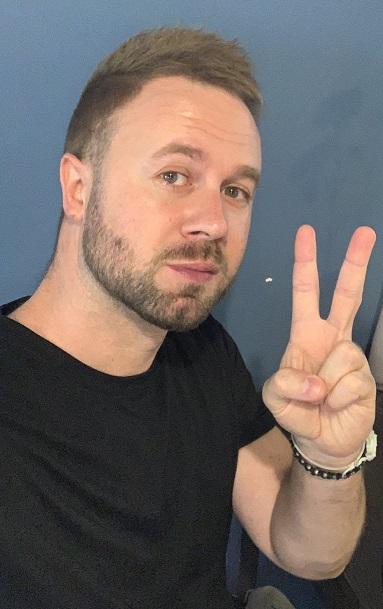
By Andrey Gnyot
To be arrested in Belarus, it is enough to choose the wrong profession. As it turns out, for such a fatal mistake you can be arrested even in the centre of Europe, for example in Serbia. And such a prestigious international organisation as Interpol will facilitate it. There is bitter sarcasm and bitter truth in my words, but I am not exaggerating. My name is Andrey Gnyot. I am a Belarusian filmmaker, journalist and former political prisoner. Here is my story.
I decided to become a journalist in 1999. Television and radio were my passion, my dream and my hobby. Could a 17-year-old have imagined that, in his country, independent journalism would be labelled extremism and all other media would be reduced to a propaganda mouthpiece? No, none of us expected this to happen in Europe in the 21st century. Yet this is exactly the situation in dictatorial Belarus today: there is not a single independent media outlet in the country. All media structures are owned by the state. The state has strict control over editorial policy, which is very simple: Lukashenko's self-proclaimed power is praised and anyone who dares to criticise it, even in a constructive way, is called the 'enemy of the people' - an epithet borrowed from the communist past.
So, in the mid-2000s, a young and naive journalism graduate tried to find his place in the profession. During and after my studies, I gained a lot of practical experience in television and radio, and I knew exactly what I wanted. But the window of opportunity was closing fast: private radio stations were shutting down or being taken over by the state, while independent TV stations couldn’t even secure a broadcasting frequency. There was little choice: either engage in propaganda, or avoid sensitive issues and limit yourself to toothless entertainment. Journalism survived in Belarus only thanks to a few newspapers and independent internet portals. Many journalists left the profession, many were subjected to repression. The Belarusian Ministry of Information regularly issued warnings to the media but just three warnings were enough to have their licenses revoked. According to the Belarusian Association of Journalists, the number of newspapers fell by 21% in 2020-2024. Only harmless publications, such as those for dacha owners, joke lovers and crossword puzzle fans, remained on the Belarusian market. All independent socio-political publications were either shut down by the authorities or chose not to go to print because it had become impossible for them to operate.
Fortunately, I was able to find a compromise solution for myself: I publicly switched to directing and creative work, where I achieved great success. At the same time, I continued my journalistic work as a volunteer, without revealing my name, so as not to be exposed. This proved to be an effective tactic. Using all my experience and professional contacts, I was able to provide the independent media with fresh video footage from 2020, and I was also able to engage in civic and political activism - I became a co-founder of the human rights civil movement 'Free Association of Athletes of Belarus SOS.BY'. I don't think I can be accused of bias and involvement, because I chose the side of the people of my country – a dictatorship has nothing to do with objectivity, just as propaganda has nothing to do with journalism.
In 2021, Belarus ranked 158th out of 180 in the press freedom rating. Compared to 2020, it dropped by five places. 'Belarus is the most dangerous country in Europe for media workers,' warns the international human rights organisation Reporters Without Borders.
Note the preferences of Belarusians in the protest year 2020: internet and social media were the main sources of news for 60% of respondents. Television - only for 11% of respondents. Print media - for 7%, and radio - for 5%. After realising this, the dictatorial regime began to act harshly and uncompromisingly. The main invention has been the fight against 'extremism' as a basis for censorship and persecution. The authorities block access to the content of media outlets that continue their activities from abroad, and any cooperation with them is considered a manifestation of extremism.
At the end of 2023, 32 journalists were imprisoned in Belarus. In detention centres, journalists have been subjected to pressure and inhumane treatment. According to human rights activists, blogger and journalist Igor Losik of 'Radio Liberty' went on hunger strike for a long time in the prison colony, and then cut his hands and neck. He was sentenced to 15 years in prison. Criminal prosecution for any form of cooperation with independent media labelled 'extremist formations' has intensified. A new trend is the persecution not only of civil society representatives, but also of ordinary citizens who comment on any social and political events for journalists.
On October 31, 2024, my personal Instagram account was declared 'extremist material' by the Belarusian regime. This means that not only I, but also all my followers in Belarus will be prosecuted for having subscribed to my account. More than 5000 Internet resources in Belarus have been declared 'extremist' by the dictatorship. Perhaps no other European country can boast such impressive statistics! Do we, Belarusians, think that enough attention is paid to the problem of Belarusian journalism? I will tell you frankly - no, there is a lack of attention to this problem. Not only is the institution of journalism being dismantled in Belarus, but journalism professionals are also being physically destroyed.
The dictatorship also tries to persecute journalists and activists outside Belarus. My example is a vivid illustration of such persecution. The regime has learned to use democratic institutions to achieve its monstrous goals. Journalists, activists, bloggers and politically active citizens have been prosecuted for tax crimes, mainly for not paying taxes in the past. This has proven to be a perfect smokescreen for hiding the political motives behind the persecution. Human rights activist and Nobel laureate Ales Bialiatski is in prison on financial charges. The editor-in-chief of the independent media outlet 'TUT.BY' (destroyed by the regime in 2020) and her colleagues are behind bars under the same financial article. The same financial crime article was accepted by Interpol for my search. It took Interpol almost eight months to conduct an internal investigation and find out that the search for me violated articles 2 and 3 of their constitution. Nevertheless, I was arrested and imprisoned in the Central Prison in Belgrade for seven months and six days. I spent five months under house arrest with severe restrictions. The Serbian Supreme Court decided twice to extradite me to dictatorial Belarus. Twice, my lawyer and I successfully appealed against this decision. In total, one year of my life, my physical and mental health was stolen from me. All because I chose the wrong profession in the wrong country. Just because I had an opinion and expressed it through active citizenship.
Fortunately, I managed to win - otherwise you would not be reading these words. Thanks to the incredible solidarity of journalists, politicians, civil society and organisations, I left Serbia and reached safety in Berlin. But my story is not over. I still have a long process of recovery and struggle ahead of me. I know that I have faithfully chosen my vocation, even if some consider it extremism. I know that independent journalism is an integral part of a democratic society. The kind that Belarusians want to build. And we expect not to be alone on this important path.