On 30 June, the Diversity Europe Group held a webinar under the banner of the Conference on the Future of Europe on the impact of the COVID-19 crisis on the mental health and employability of young people.
With recent surveys showing that 66% of Europeans would like the EU to have more say over health-related matters, and more than a half in favour of public health becoming the EU's top priority in terms of expenditure, the EU should start playing a more active role in protecting the health of its citizens. The EESC thinks that the Commission's recent package on an EU Health Union is a step in the right direction.
Il nuovo piano europeo di lotta contro il cancro, ambizioso e olistico, ha ottenuto il plauso delle organizzazioni del settore e della società civile. Ora, poiché la pandemia sta avendo pesanti ripercussioni sulla diagnosi e la cura del cancro, il piano deve essere attuato con urgenza e in modo adeguato. La posta in gioco è altissima: senza un'azione decisiva, l'Europa potrebbe trovarsi di fronte a un vero e proprio tsunami oncologico, con il quale, in poco meno di 15 anni, il cancro diventerebbe la principale causa di morte.
Confrontate a tante barriere e con minori possibilità di mantenere la distanza sociale e fisica, le persone con disabilità sono più esposte al rischio di contrarre la COVID-19 e di sviluppare una forma grave della malattia. Tuttavia, nell'UE non sono state esplicitamente incluse nei gruppi prioritari per la vaccinazione.
COVID-19 has blatantly exposed all the cracks and fissures in the European health systems and shown the EU to be unprepared for dealing with major health emergencies. But the first building blocks of the future European Health Union, recently proposed by the Commission, look promising and may give the EU the right weapons to fight pandemics in the future
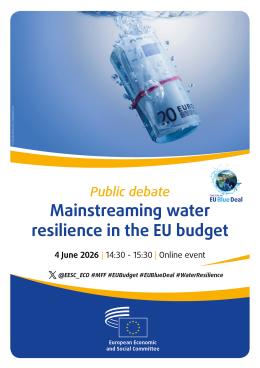
Mainstreaming Water Resilience in the EU Budget is a timely discussion on securing Europe’s water future. Discover how smarter EU investments can strengthen water resilience, sustainability, and preparedness, and how we should shape tomorrow’s funding priorities across programmes in the context of the EU´s next Multiannual Financial Framework.
Joint Conference of the Minister for Civil Society of the Republic of Poland and the EESC Civil Society Organisations' Group
Event type
Conference
Location
Chancellery of the Prime Minister
Warsaw
Poland
The conference will be held on 15 May 2025 at the Chancellery of the Prime Minister in Warsaw, Al. Ujazdowskie 1/3, as part of the Polish Presidency of the Council of the EU.
Medical University of Warsaw, 2a Księcia Trojdena Street
Warsaw
Poland
The European Economic and Social Committee (EESC), the Polish Ministry of Health, and the Medical University of Warsaw is holding a major conference entitled Towards an EU Action Plan on Rare Diseases on 10 April 2025 at 9 a.m. at the Medical University in Warsaw, Poland.