Social dialogue is an important tool for ensuring health and safety at work. However, in the face of changes brought to the world of work by the digital and green transition and the health crisis, social dialogue will have to be strengthened across Europe. It should be complemented by more robust rules on musculoskeletal disorders and psychosocial risks leading to major work-related illnesses such as heart conditions, stroke, cancer and depression
Interactio and Room JDE 62, EESC building, Rue Belliard 99, 1040
Brussels
Belgium
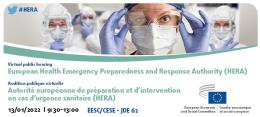
In order to prepare its opinion on the European Health Emergency Preparedness and Response Authority (HERA) proposal by the European Commission, the EESC is organising a remote public hearing on 13 January 2022 from 9:30 am to 1 pm.
The aim of the event is to discuss the proposal and gather input from other EU Institutions, civil society, social partners and health professionals, which will feed into the EESC's opinion.
The pandemic has made it even more urgent to address the new challenges for health and safety at work. Enhanced social dialogue is required to guarantee better standards in teleworking and, more generally, in the digital environment
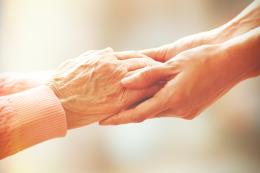
The excessive mortality rates during this pandemic crisis have revealed structural and systemic problems in the nursing home care model. In addition, the rise in life expectancy and the consequent increase in the number of older persons in the years to come, point out the need to reform the care model. How to guarantee improved accessibility, affordability and quality of care, as well as an adequate number of care workers with improved working conditions, are among the key challenges identified during the EESC hearing "Towards a new care model for the elderly: learning from the Covid-19 pandemic".
In this opinion, the EESC presents its view on the Commission's proposal establishing the European Health Emergency Preparedness and Response Authority. (HERA), whose mission is to prevent, detect, and rapidly respond to transnational health emergencies. The EESC welcomes this initiative but is concerned by the very limited role given by HERA to the European Parliament, regional authorities, health insurance bodies and civil society organisations and recommends their stronger involvement by adapting HERA structure and ensuring greater transparency with regard to the funds allocated and spent by and through HERA.
Download format:
Download — EESC opinion: European Health Emergency Preparedness and Response Authority (HERA)
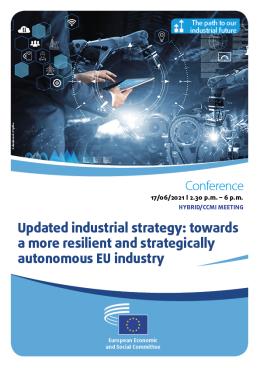
Following the publication of the European Commission's Update to the New Industrial Strategy, the European Economic and Social Committee (EESC) has been carrying out a series of activities to fulfil its role of representing the views of organised civil society. A key event in this process has been a conference held on 17 June 2021, from 2.30 to 6 p.m., on Updated industrial strategy: towards a more resilient and strategically autonomous EU industry.
Interactio and Room JDE 60, JDE building, Rue Belliard 99, 1040
Brussels
Belgium
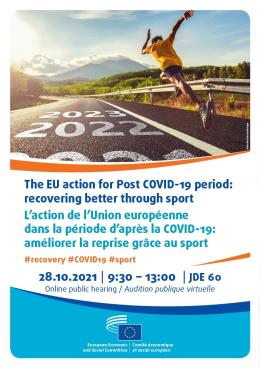
In order to prepare its own-initiative opinion, the EESC is organising a public hearing on " The EU action for Post COVID-19 period: recovering better through sport " on 28 October 2021.
Interactio and Room VMA3, VMA building, Rue Van Maerlant 1, 1040
Brussels
Belgium
In order to prepare its own-initiative opinion, the EESC is organising a remote public hearing on "Towards a new care model for the elderly: learning from the Covid-19 pandemic" on 27 October 2021.
The aim of the event is to gather input from other EU Institutions and civil society organisations.
We will debate around the following questions:
Which are the structural causes that have led to the elderly care systems to become some of the most contagious and lethal factors of this pandemic?
What are the strengths and weaknesses of the various care models in the EU?
Which are the civil society perspective and proposals for a new care model for the elderly?