EESC with this Resolution, calls on the Member States of the European Union and its leaders, the European institutions and the EU citizens, to safeguard and protect the economic, social and territorial cohesion of the EU according to Article 174 of the TFEU.
The fundamental principle of cohesion policy, according to which ‘no one should be left behind’, remains sound and valid. Civil society partners are ready to continue working towards it by means of a solid EU investment policy.
Lessons learned from the first years of the implementation of the programming period 2021-2027
Event type
Debate
Location
Online event
Belgium
Public debate on 9th Cohesion report: Lessons learned from the first years of the implementation of the programming period 2021-2027, in the framework of the ECO section meeting.
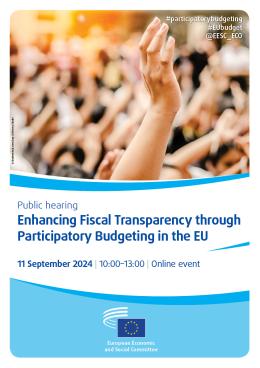
The need for open and transparent budgetary processes has never been more critical. The multiannual financial framework (MFF) emerges as a crucial tool for aligning financial resources with the Union's long-term priorities. The EESC has highlighted significant gaps in the current MFF, including its limited scope in addressing contemporary challenges such as Europe's aging population and strained budgets due to inflation.
The EESC therefore explores a paradigm shift towards Open budgets in the EU –a framework that encompasses not only participatory budgeting but a broader spectrum of fiscal transparency and citizen engagement across all stages of the budget cycle. This approach is aimed at enhancing the responsiveness and effectiveness of EU budget allocations, thereby fostering a more resilient, inclusive, and democratic European economy.
According to Article 175 of the TFEU the Commission shall submit a report to the European Parliament, the Council, the Economic and Social Committee and the Committee of the Regions, every three years, on the progress towards achieving economic, social and territorial cohesion.
The 9th report which covers the first period (2021-2023) of the programming period 2021-2027 will include a record of progress made towards achieving economic, social and territorial cohesion, including the socio-economic situation of regions as well as the integration of EU priorities. It will also include, where appropriate, an indication of future EU measures and policies necessary to strengthen cohesion, as well as to deliver EU priorities.
Some 42% of Europe's older population report that age discrimination is prevalent in their country, with ageism peaking in the workplace. As the proportion of people over 65 is set to steadily rise in the coming decades, the EU is in dire need of a comprehensive strategy which will allow for a fundamental change, both in policies and in society's perception of older people