
European Economic
and Social Committee
GENDER EQUALITY BY 2197? THE EESC CALLS FOR URGENT ACTION
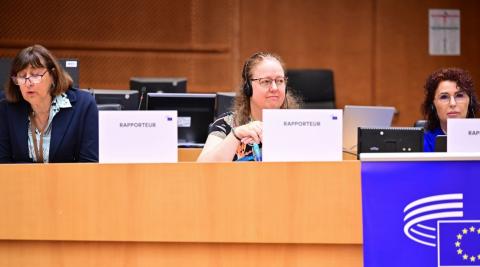
With the UN's targets still off track for 2030, the European Economic and Social Committee (EESC) is calling for faster action. In a resolution setting out the EESC contribution to the EU's priorities at the 71st session of the United Nations Commission on the Status of Women (UN CSW71), the Committee has highlighted a number of barriers that continue to hinder women's economic independence and leadership, and has emphasised the fact that widespread gender-based violence remains a significant problem.
The United Nations Sustainable Development Goals (SDG) set 2030 as the target for achieving gender equality. But at the current pace, according to UN estimates, it will take 171 years to achieve this goal, pushing out gender equality to the year 2197. In a resolution drawn up by rapporteurs Giulia Barbucci, Juliane Marie Neiiendam and Christa Schweng and adopted at its September 2026 plenary session, the EESC is calling for more proactive and ambitious measures to be taken by the EU institutions, its Member States and the international community.
'CSW71 is a crucial opportunity to turn promises into measurable progress. With 2030 fast approaching, employers, trade unions and civil society must help advance gender equality through decent work, entrepreneurship, leadership, digital skills, quality care and climate action', declared the three rapporteurs.
In its resolution, the EESC stresses that progress towards gender equality remains uneven, fragile and increasingly contested, at national, EU and global level. The so-called 'glass ceiling' in the corporate world remains a pressing problem. According to the UN's 2026 Gender Snapshot, which tracks progress towards the Sustainable Development Goals, women account for around 40% of employees in firms worldwide but hold just 5.8% of the CEO positions in the publicly traded companies covered by the report and only 25.1% of the corporate board seats.
The resolution underlines that gender-based violence remains one of the most significant barriers to equality and empowerment and that preventing and combating violence against women and girls, including digital violence, must remain a political priority.
Nearly one in three women aged 15 or older – an estimated 840 million globally – has experienced partner or sexual violence during her lifetime, a figure that has barely budged since 2000. In the last 12 months, 316 million women – 11% of those aged 15 or older – were subjected to physical or sexual violence by an intimate partner.
Background
The 71st session of the UN CSW will take place in March 2027 at the UN in New York. The session will focus on the priority topic of accelerating the achievement of gender equality and the empowerment of all women and girls in the context of the 2030 Agenda for Sustainable Development. (ab)