
European Economic
and Social Committee
EESC steps up relations with the Brazilian civil society, reinforcing EU's strategic partnership with Brazil
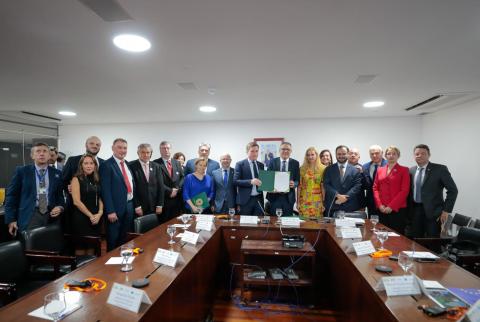
On 9 April, the President of the European Economic and Social Committee, Oliver Röpke signed a Memorandum of Understanding with the newly established Sustainable Economic and Social Development Council of Brazil (CDESS), represented by Minister Alexandre Padilha. The memorandum strengthens cooperation between the EU and Brazilian civil societies on environmental, economic and social issues, reaffirming Brazil's strategic partnership with EU and promoting renewed democratic dialogue.
During his visit to Brazil, President Röpke met with President Lula da Silva, who reinstated the Brazilian Sustainable Economic and Social Development Council was re-established in 2023 after its dissolution in 2018. President Röpke reiterated the EU's commitment to enhancing the strategic partnership with Brazil and supported President Lula da Silva's initiative for a more inclusive and participatory democracy, aiming to safeguard fundamental values, rule of law and human rights.
EESC President Oliver Röpke said: "A strong civil society is the best watchdog for any democracy – whether in the EU or Brazil. Today, we empower the civil society with tools to do its job, especially when it comes to sustainable development but also the protection of our democratic principles. I would like to thank President Lula da Silva for his leadership. Brazil is the EU's strategic partner, and we need to stand together to defend our democracies."
EU-Brazil civil society: a democratic watchdog
The Memorandum outlines cooperation between the EESC and CDESS as the legitimate and democratic instruments for consulting society, focusing on environmental, economic and social matters. It acknowledges the need for increased cooperation, committing EESC and CDEES to exchange of information regularly, organise joint activities like trainings, conferences, and research, and take initiatives through regional structures (such as Mercosur).
The EESC and CDESS also agreed to discuss the role and experiences of economic and social councils as bridges between civil society and public authorities; and to provide a platform for civil society with to debate domestic and international issues.
Background
In 2003, the EESC signed its first Memorandum of Understanding with Brazil's Economic and Social Development Council (CDES), paving the way for a structured dialogue and cooperation between both institutions. The Memorandum materialised in regular meetings of the EU-Brazil Civil Society Round Table and other important joint initiatives until the dissolution of the CDES in 2018.
In 2023, Brazil's newly appointed government recreated the Council, strengthening its environmental dimension, as the Sustainable Economic and Social Development Council of Brazil (CDESS). EESC and CDESS expressed interest in reviving their cooperation to bring civil society on both sides together to share experience and discuss mutual interests.
Recommended for you
Decision repealing Directive 89/629/EEC
Opinion
FŐBB PONTOK Az EGSZB: megfelelőnek tartja a javaslat tartalmát, és részéről további megjegyzést nem kíván hozzáfűzni, ezért úgy határozott, hogy a javaslattal kapcsolatban támogató véleményt…
Az egészségügyi ágazatbeli közszolgáltatások közös létrehozása erősíteni fogja a demokrácia részvételi jellegét az EU-ban
News
Az Európai Gazdasági és Szociális Bizottság (EGSZB) és a Debreceni Egyetem által szervezett rendezvény rávilágított, mennyire fontos az általános érdekű szolgáltatások közös létrehozása az…
Co-creation and services of general interest in the field of health and well-being
Event
Az Európai Gazdasági és Szociális Bizottság és a Debreceni Egyetem magas szintű, rangos nemzetközi tudományos-szakmai konferenciát szervezett 2022. szeptember 15-16-án, Debrecenben. A konferencia…
RePowerEU Plan
Opinion
FŐBB PONTOK Az EGSZB: úgy véli, hogy az Európai Bizottság REPowerEU terve a helyes irányba tett lépés ahhoz, hogy az EU függetlenné váljon az orosz gáz- és kőolajellátástól, rámutat arra, hogy a…
Individual and collective energy self-consumption as a factor in the fight for the green and energy transition, and for economic and social balance
Opinion
Az egyéni és kollektív energiafogyasztás mint a zöld és energetikai átállásért, valamint a gazdasági és társadalmi egyensúlyért folytatott küzdelem egyik tényezője Főbb pontok Az EGSZB: úgy véli…