
European Economic
and Social Committee
Meet our members | Javier Garat on healthy oceans, competitive maritime sectors and thriving coastal communities
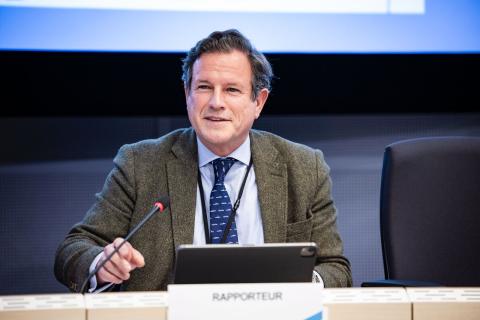
Javier Garat is the current president of the Association of National Organizations of Fishing Enterprises in the European Union (Europêche). He has been an EESC member since 2020, participating in the NAT (Agriculture, Rural Development and the Environment) and REX (External Relations) sections.
Last year, the EESC adopted exploratory opinion NAT/944, at the request of the European Commission, on civil society’s recommendations towards a European Ocean Pact. Looking back, what do you consider to be the opinion’s main contribution, particularly in promoting a more integrated and sustainable approach to ocean governance? What are your expectations for the next steps in developing the European Ocean Act?
The main contribution of the EESC opinion was to promote a positive and forward-looking vision for Europe’s seas and oceans. It emphasised the need to unlock the full potential of the blue economy by fostering a competitive, innovative and resilient business environment, supported by a simplified regulatory framework, while ensuring that economic development remains within planetary boundaries.
The opinion advocated a genuinely integrated approach to ocean governance, bringing together all maritime sectors and strengthening coherence across EU policies. It also highlighted the importance of investing in innovation, skills, ocean science and maritime industries, while reinforcing support for the communities and businesses whose livelihoods depend on the sea.
Looking ahead, I hope that the European Ocean Act will build on these foundations and become a true enabler of sustainable growth, competitiveness and innovation. Europe has enormous maritime potential, but unlocking it requires policy coherence, investment, a level playing field and effective maritime spatial planning. The Ocean Act should create the conditions to deliver jobs, food security, renewable energy and environmental stewardship. At the same time, it must ensure that traditional sectors such as fisheries are fully involved in decision-making, retain fair access to their traditional fishing grounds and are not further constrained by the increasing competition for maritime space.
You recently welcomed to our premises Commissioner Kadis for the high-level conference on the role of regional fisheries management organisations in the implementation of the agreement on biodiversity beyond national jurisdictions (BBNJ), co-organised by the EESC. Would you say that the recommendations you made in opinion NAT/959 on BBNJ have been heard?
I believe the key messages are increasingly being recognised. The opinion stressed that the successful implementation of the BBNJ Agreement should build on existing international governance structures rather than duplicate them. In the field of fisheries, regional fisheries management organisations (RFMOs) have a central role to play, given their long-standing experience in managing marine resources through science-based advice, international cooperation and compliance mechanisms. This was clearly reflected at the EESC conference, where representatives from RFMOs around the world, together with the FAO, DOALOS, NGOs and industry, shared their views and concrete actions.
Commissioner Kadis’s participation also showed that there is growing awareness of the need for coordination between all competent bodies involved in ocean governance. The challenge now is to ensure that BBNJ implementation strengthens cooperation, legal certainty for the maritime sectors and coherence across international frameworks. The EESC has consistently called for an inclusive approach involving governments, scientists, civil society and ocean users. This remains essential if BBNJ is to deliver real conservation results while allowing sustainable ocean-based activities to continue.
Through your work on fisheries and ocean governance files, you have consistently highlighted the need to balance environmental protection with the sustainability of maritime activities. Looking ahead, what do you see as the main challenges and opportunities for achieving healthy oceans while maintaining thriving coastal and maritime communities?
The biggest challenge is ensuring that Europe’s maritime sectors remain competitive while continuing to improve the environmental performance of our oceans. Today, many sectors that are essential for food production, shipbuilding or transport are facing growing regulatory complexity, rising costs and increasing competition. This is affecting investment, innovation and, ultimately, jobs in coastal communities.
At the same time, climate change and pollution require decisive action. The solution is not to choose between environmental protection and economic activity, but to pursue both through smart, evidence-based policies. This means ensuring adequate funding for innovation, decarbonisation, skills and infrastructure and simplifying regulations, reducing unnecessary administrative burdens.
There are significant opportunities ahead. Innovation, digitalisation, better marine science and improved maritime spatial planning can help reconcile environmental and economic objectives. Coastal communities should be seen as key partners in this transition. If Europe provides the right framework, including investment support and regulatory certainty, we can have healthy oceans, competitive maritime sectors and thriving coastal communities at the same time.