On 7 March, the European Economic and Social Committee (EESC) will award its 14th Civil Society Prize, dedicated to mental health, to five non-profit projects: two from Finland and one each from Italy, Ireland and Slovakia.
Le Comité économique et social européen (CESE) décerne cette année son emblématique prix de la société civile à des projets sans but lucratif qui favorisent le bien-être mental des Européens.
Young people's mental health is being increasingly compromised by the excessive use of social media, concerns about climate change and a sense of powerlessness. This is a "political" issue for the EU because it can often be linked to the labour market and housing situation facing young people
Alors que la santé mentale des Européens se détériore, le CESE presse les décideurs politiques à l’échelon de l’Union européenne et de ses États membres d’en faire une priorité absolue.
Organisations de la société civile, particuliers et entreprises privées peuvent désormais soumettre leurs projets à but non lucratif dans l’espoir de décrocher ce prix du CESE, axé sur le soutien au bien-être mental des Européens
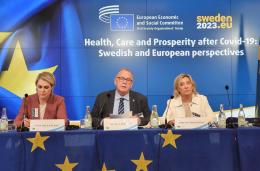
Healthcare must be people-centred and valued as a social investment, not a 'cost', concluded a conference organised by the Civil Society Organisations' Group of the EESC at the House of Europe in Stockholm on 25 May 2023. For this to happen it is necessary to change mindsets socially, economically and politically. Building on cooperation during the COVID-19 pandemic, EU Member States need to join forces to build resilient and sustainable health and care systems that leave no one behind and value the work of care workers, civil society organisations and volunteers.
À l’occasion de l’édition 2023 de la Journée mondiale de la santé et de la sécurité au travail, le Comité économique et social européen demande à la Commission européenne d’adopter une législation contraignante pour prévenir les risques psychosociaux au travail. Les preuves s’accumulent, montrant que le travail précaire fait payer un lourd tribut aux travailleurs sur le plan de leur santé mentale. Le CESE a lancé son appel lors de sa session plénière tenue hier, qui était présidée pour la première fois par M. Oliver Röpke, tout nouvellement élu à la tête du Comité.
The EESC proposed to make sure that the relevant European and national legislation is fully implemented and enforced so as to reduce precarious work and the prevalence of the associated mental health problems;
to adopt specific legislation on preventing psychosocial risks at EU level;
to combat identified work-related psychosocial risks at the source.