Food sustainability

This page is also available in:

Food is at the centre of our lives and an integral part of the European culture. However, the food we eat, the ways we produce it and the amounts wasted have major impacts on human health, natural resources and society as a whole:

  • Citizens –and children in particular– are increasingly suffering from overweight and obesity due to unhealthy diets.
  • Farmers and workers do not get a fair price for their produce.
  • One third of food is lost or wasted across the food chain.
  • The environment is paying the bill with the dramatic effects of food production and consumption on climate change, loss of biodiversity, air and water pollution, soil degradation, etc.

The COVID-19 crisis is a wake-up call for change. It has demonstrated that getting food "from farm to fork" cannot be taken for granted and has shown the interconnectedness of actors and activities throughout the food system. Fair, resource efficient, inclusive and sustainable supply chains in the whole agriculture and food sector are needed more than ever to deliver equally for citizens, farmers, workers and business.

The EESC has been for years at the forefront of calling for a sustainable and comprehensive food policy. Such an integrated and systemic approach is essential to tackle the multiple and interconnected challenges affecting food systems; to deliver economic, environmental and socio-cultural sustainability; to ensure integration and coherence across policy areas (such as agriculture, environment, health, education, trade, economy, technology, etc.); and to promote cooperation across levels of governance

  • Adopted on 05/05/2011
    Reference
    NAT/504-EESC-2011-01-01-811
    Employers - GR I
    Spain
    Plenary session number
    471
    -
    Download — EESC Opinion: Agricultural product quality schemes
  • Adopted on 05/05/2011
    Reference
    NAT/503-EESC-2011-810
    Civil Society Organisations - GR III
    Bulgaria
    Plenary session number
    471
    -
    Download — EESC Opinion: Contractual relations in the milk and milk products sector
  • Adopted on 20/01/2011
    Reference
    NAT/483-EESC-2011-68
    Civil Society Organisations - GR III
    Spain
    Plenary session number
    468
    -
    Download — EESC Opinion: Fruit Juices
  • Adopted on 09/12/2010
    Reference
    NAT/468-EESC-2010-1622
    Civil Society Organisations - GR III
    Austria
    Plenary session number
    467
    -
    Download — EESC Opinion: Security of supply in agriculture and the food sector in the EU
  • Adopted on 28/04/2010
    Reference
    NAT/455-EESC-2010-648
    Employers - GR I
    Spain
    Civil Society Organisations - GR III
    Spain
    Plenary session number
    462
    -
    Download — Strengthening the European agri-food model
  • A new report on Europe’s progress toward the Sustainable Development Goals (SDGs) highlights a significant slowdown, raising concerns about the EU’s ability to meet the 2030 targets. The Europe Sustainable Development Report 2025 (ESDR), published by the UN Sustainable Development Solutions Network (SDSN), finds that the pace of SDG progress between 2020 and 2023 was more than twice as slow as in the previous period.

  • The European Economic and Social Committee (EESC) has laid out a bold vision for transforming the EU's agriculture, fisheries, and food systems to better withstand crises while ensuring sustainability. The opinion "Fostering sustainable and resilient food systems in times of crisis," requested by the Hungarian presidency, was adopted at the October plenary.

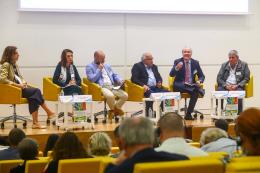
  • On 12-13 September 2024, the NAT Bureau meeting was held in Hungary where members exchanged views and experiences with various stakeholders on how to foster sustainable and resilient food systems at times of growing crises.

  • During its section meeting of 22 November 2023, the NAT section held a debate on food speculation as a follow up of its opinion on "Food price crisis: the role of speculation and concrete proposals for action in the aftermath of the Ukraine war".

  • Fair prices for both farmers and consumers and truthful and transparent information are essential if the primary sector and consumers are to play their key role in guaranteeing strategic autonomy in European food production. This sovereignty must be in line with the European Green Deal's Farm to Fork strategy, which requires an adjustment of current food policies.