
European Economic
and Social Committee
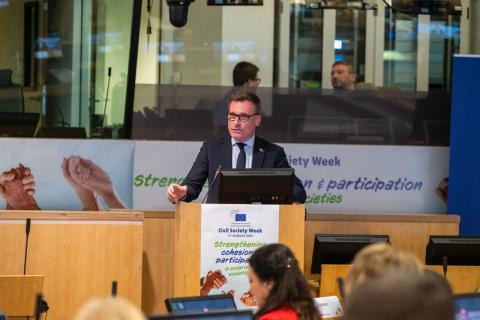
More than 800 participants from citizens’ organisations and stakeholders across Europe, including youth organisations, NGOs and journalists, joined the Civil Society Week, held by the European Economic and Social Committee from 17-20 March 2025. The opening session signalled the protection of the civic space through legal action, reaffirming the key role of civil societies: hold power accountable, build bridges, support social resilience and give a voice to those who are too often ignored.
The theme of the 2025 edition of Civil Society Week was Strengthening cohesion and participation in polarised societies. With its three major initiatives, namely the Liaison Group panels, the European Citizens’ Initiative and the Civil Society Prize, the event aimed to:
- address the growing polarisation that has been fuelled in recent years by the impact of the financial crisis, climate change and growing income inequality;
- highlight the key role that civil society can play in this context;
- gather civil society’s solutions and demands for EU policy-makers in order to help depolarise Europe by strengthening societal cohesion and democratic participation in key areas for society.
In his opening speech, EESC president Oliver Röpke stressed: ‘Civil society must rise to the challenge. Participation, dialogue and solidarity are not just ideals – they are the foundation of a resilient and united Europe. As we gather for Civil Society Week, let us reaffirm our commitment to inclusion and active citizenship. A strong democracy depends not just on institutions, but on the engagement of all its people.’
Albena Azmanova, Professor of Political and Social Science at City St George’s, University of London, talked in her keynote address about the growing economic insecurity faced by the majority of people – what she called an 'epidemic of precarity’. She explained why civil society holds the key to a breakthrough in times of massive insecurity.
‘Massive economic insecurity has drained most people of the will to fight. Civil society has the will to fight. Civil society activists are driven by a sense of purpose defined by a specific grievance. They are the visible legs and arms of democracy,’ she said.
As Younous Omarjee, Vice-President of the European Parliament, put it ‘We need civil society as a glue between citizens, in this context of rising individualism, and as a rampart against the far-right ideas that are spreading.’
The crucial role of NGOs in social resilience and their support for vulnerable and remote groups was raised by Adriana Porowska, Minister for Civil Society, from the Polish EU Presidency, who also shared the Polish experience with civil society ensuring national resilience.
Brikena Xhomaqi, co-chair of the EESC Liaison Group with European civil society networks, stressed that unity in diversity, the EU’s proud mantra, is cultivated at the grassroots level. However, Ms Xhomaqi mentioned that civil society organisations and NGOs are under attack, with their funding and role coming into question. ‘Without resources, civil society organisations cannot function. We need the institutions to protect civil society; we need legal protection for the civic space to keep our society together and united in diversity.’