Russland

This page is also available in:

Der Begleitausschuss EU-Russland ist das interne Gremium des EWSA, das für die Aufrechterhaltung der Beziehungen zur russischen Zivilgesellschaft zuständig ist.

Seit die Regierung der Russischen Föderation am 24. Februar 2022 den Krieg gegen die Ukraine begonnen hat, wurde die freie Zivilgesellschaft in Russland durch Sondergesetze und wachsende Repressionen zum Schweigen gebracht. Viele Kritiker des Regimes waren gezwungen, ins Exil zu gehen.

Trotz der aktuell schwierigen Lage hat der EWSA beschlossen, sich dem Dialog nicht zu verschließen, sondern ihn mit dem Teil der russischen Zivilgesellschaft, der sich in der EU aufhält und den Krieg ablehnt, aufrechtzuerhalten.

Das Ergebnis ist ein fruchtbarer Informations- und Meinungsaustausch darüber, wie die bilateralen Beziehungen nach dem Ende des Krieges und einer Rückkehr zu Freiheit und Demokratie aussehen sollten.


  • verabschiedet on 13/05/2009
    Referenz
    REX/271-EESC-2009-01-01-889
    Employers - GR I
    Czech Republic
    Plenary session number
    453
    -
    Download — Civil society – Eastern Partnership
  • Referenz
    REX/371-EESC-0000-01-01-1813
    Employers - GR I
    Finland
    Plenary session number
    489
    -
    L'avis se penchera sur les questions relatives aux dimensions économique, sociale, environnementale et humaine du caractère croissant de l'utilisation des richesses de l'Arctique, et sur le rôle potentiel de la société civile pour exprimer les intérêts des groupes concernés ainsi que pour soutenir la position de l'UE dans le cadre du dialogue avec les partenaires internationaux concernés.
    Download — La politique arctique de l'UE pour aborder les nouveaux enjeux mondiaux dans la région – point de vue de la société civile
  • Reference number
    25/2023

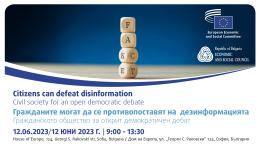
    On 12 June, the EESC launched its first event on fighting disinformation, kick-starting an awareness-raising campaign ahead of the European Parliament elections in 2024. The event, which gathered prominent figures from the civil society, media and youth organisations, highlighted the need for a more bottom-up approach with a strong civil society network countering disinformation on the ground. However, political awareness and solid legislative framework together with independent media are also crucial in the fight against fake news penetration.

  • Cohesion policy is key to overcoming the COVID-19 crisis, to achieving climate neutrality by 2050 and to reducing disparities in Europe. Its most serious challenge for the foreseeable future, however, is the war in Ukraine, the EESC cautions in a recent opinion. Rapid action is needed to help refugees and ensure the country's European integration.

  • Civil society for an open democratic debate
    Event type
    Conference

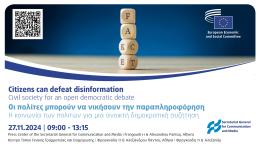
    This conference in Athens is the third event on disinformation being hosted by the European Economic and Social Committee (EESC) as part of its ongoing project aiming to fight disinformation with the help of civil society.

  • Civil society for an open democratic debate
    Event type
    Conference

    The European Economic and Social Committee (EESC) is working on a project on disinformation to be implemented with the help of civil society. Disinformation typically spreads among the population, often horizontally, so that the best way to tackle the problem is not in a top-down approach, but in citizens’ reflection and direct engagement. This is where organized civil society can play a crucial role.

  • -
    Event type
    Meeting
  • Published in
    8 pages

    The External Relations Section (REX) of the European Economic and Social Committee (EESC) is responsible for dialogue between European civil society organisations and their homologues from the countries with which the European Union has formal relations (e.g. under the form of a Free Trade Agreement). Through this dialogue, made possible by a series of bilateral bodies, and through specialized opinions and information reports, the Committee is able to concretely contribute to EU foreign policy.