GRAND PLAZA HOTEL & CONGRESS CENTER
Slovenska cesta 60
Ljubljana
Slovenia
The Western Balkans Civil Society High-Level Conference brought together EESC members, organised civil society representatives from the Western Balkan countries, and members of organised civil society and officials from Slovenia. It marked 20 years of the biggest EU enlargement thus far, and 20 years since Slovenia joined the Union. The conference was organised in close cooperation with and support from our partners and will complement the EESC’s work, such as the Western Balkans Civil Society Forum, which the EESC has organised every two years since 2006. The event provided an opportunity for participants to exchange views on the needed reforms in the Western Balkans and in the EU to maintain enlargement policy as one of the most important EU success stories. It was an opportunity to discuss the current situation of civil society in the region and the need for its better inclusion in the accession process. The participants adopted conclusions addressed to national authorities and European institutions.
recommends that the Commission issue clear and transparent guidance on how to apply the proposed conditionality package and also reiterates the importance of ensuring that the EU's focus on stability and geopolitical interests does not come at the expense of the rule of law and democracy;
asks the Commission to support candidate and potential candidate countries in evaluating both the advantages and drawbacks of early market integration, identifying those that are adversely affected and implementing customised mitigation measures;
reiterates the importance of regional cooperation and good neighbourly relations throughout the EU accession process and welcomes the focus in the Commission's proposal on developing the Common Regional Market (CRM).
The EU-Serbia Joint Consultative Committee (JCC) held its 17th meeting on 5 April 2024 at the EESC in Brussels, Belgium. It is a platform established within the institutional framework of the EU‑Serbia Stabilisation and Association Agreement (SAA), enabling representatives of both the EU and the Serbian civil society to monitor the country's accession negotiations, discuss issues of common interest and point out concerns to be tackled on the Serbian path towards the European Union.
Stara zgrada Vlade Crne Gore
Ulica Jovana Tomaševića bb
Podgorica
Montenegro
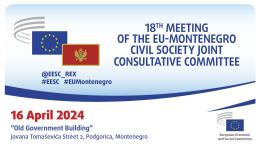
For the 18th time, the European Economic and Social Committee (EESC) and Montenegro held the Civil Society Joint Consultative Committee (JCC) in Podgorica on 16 April 2024. The JCC is a civil society platform established between the EESC and Montenegrin civil society.
HOTEL INTERNATIONAL PRISHTINA, RR. SHKUPI, VETERNIK
Pristina, KOSOVO
This years' meeting of the EESC's Western Balkans Follow-up Committee outside of Brussels took place on 29 March 2023 in Pristina, Kosovo, and it included a hearing with the local civil society organisations (CSOs).
The goal of the hearing was to listen to the views on the role of civil society in Kosovo as well as to hear their concerns, and to convey these messages to the political authorities of Kosovo and of the EU.
The following topics were discussed at the hearing:
2023 European Year of Skills: skills, education and youth policy in Kosovo
State of social dialogue in Kosovo
Enabling civic space in Kosovo
@EESC_REX #EESC_WB
* This designation is without prejudice to positions on status, and is in line with UNSCR 1244/1999 and ICJ Opinion on the Kosovo declaration of independence.
Judging by recent events, migration can be unpredictable and unprecedented, with EU policy being anticipatory and yet reactive. This paper highlights recent EU policy and developments, and the EESC's position in response to them.
The External Relations Section (REX) of the European Economic and Social Committee (EESC) is responsible for dialogue between European civil society organisations and their homologues from the countries with which the European Union has formal relations (e.g. under the form of a Free Trade Agreement). Through this dialogue, made possible by a series of bilateral bodies, and through specialized opinions and information reports, the Committee is able to concretely contribute to EU foreign policy.
The EU-Serbia Joint Consultative Committee (JCC) held its 15th meeting on 21 April 2023 in Brussels, Belgium. It is a platform established within the institutional framework of the EU‑Serbia Stabilisation and Association Agreement (SAA), enabling representatives of both the EU and the Serbian civil society to monitor the country's accession negotiations, discuss issues of common interest and point out concerns to be tackled on the Serbian path towards the European Union.
For the 16th time, the European Economic and Social Committee (EESC) and Montenegro held the Civil Society Joint Consultative Committee (JCC). The JCC is a civil society platform established between the EESC and Montenegrin civil society. It complements with a civil society point of view the EU institutional framework related to the Stabilisation and Association Agreement between the EU and Montenegro. This joint institution allows civil society organisations on both sides to monitor the country's accession negotiations. It is also a platform to discuss issues of common interest and to inform the public at large on the challenges ahead during the accession period.
This 16th JCC took place in Podgorica and tackled issues such as:
Current state of play in EU-Montenegro relations, including 2022 Montenegro Report
Revised enlargement methodology – Cluster 1: The Fundamentals of the Accession Process, with a special focus on Judiciary and Fundamental rights and the Functioning of democratic institutions
Revised enlargement methodology – Cluster 1: The Fundamentals of the Accession Process, with a special focus on Justice, Freedom and Security
Overview of the civil society situation in Montenegro
A joint declaration was adopted at the meeting and will be distributed to all relevant EU institutions, as well as to the Montenegrin authorities.