The focus of current informal discussions in the Council is on how cohesion policy can adjust to the new circumstances following the unforeseen shocks that Europe has faced in the last years without losing its long-term development goals. The Spanish Presidency refers to "Cohesion policy 2.0" in this context, which particularly means that cohesion policy needs to be transformed and become more modern and flexible. Also, it will need to take into account the RRF which will come to an end at some time.
Download format:
Download — Stellungnahme des Ausschusses: The Recovery and Resilience Facility and cohesion policy: towards cohesion policy 2.0
The EESC proposed to make sure that the relevant European and national legislation is fully implemented and enforced so as to reduce precarious work and the prevalence of the associated mental health problems;
to adopt specific legislation on preventing psychosocial risks at EU level;
to combat identified work-related psychosocial risks at the source.
The EESC considers the Social Imbalance Procedure (SIP) an opportunity to enhance the coordination of national efforts to improve their social governance and reduce social inequalities within a country and between Member States
underlines that the SIP should be integrated into the European Semester, throughout its different phases
calls on the Commission and the Member States to consider making existing rules for funds allocation (including the ESIF, RRF and others) more flexible.
How can these regions become drivers for growth and development?
Event type
Public hearing
Location
Umeå Folkets hus,
Skolgatan 59
Umeå
Sweden
The European Economic and Social Committee (EESC) will be producing an own-initiative opinion on the main challenges faced by EU islands and mountainous and sparsely populated areas, which is scheduled for adoption at the EESC's September plenary session. In this context, the EESC, along with the Conference of Peripheral Maritime Regions (CPMR) and the North Sweden European Office (NSEO), will be holding a public hearing in Umeå (Sweden) on 4 May 2023 entitled "Challenges and opportunities that the digital and energy transitions present to the northern sparsely populated areas and islands. How can these regions become drivers for growth and development?". The hearing is an event under the Swedish Presidency of the Council of the EU.
Every year in February, the EESC adopts an opinion on Annual Sustainable Growth Survey, which the Commission usually presents at the end of November in the year before. The Committee works under tight deadlines, in anticipation of the referral, to finalise the opinion before the March Council discussion on the topic. To reinforce the Committee's impact throughout the entire European Semester, an own-initiative opinion with additional considerations is regularly produced by October taking into account the overall European Semester, which plays a central role in implementing the Recovery and Resilience Facility and is vital in current discussions about the review of the EU macro-economic governance framework.
Download format:
Download — Stellungnahme des Ausschusses: Additional considerations on the Annual Sustainable Growth Survey 2023
The Social Progress Protocol, proposed during the Conference on the Future of Europe (CoFoE), gives precedence to social, workers' and trade union rights when they are in conflict with economic freedoms. However, while everyone agreed that social rights and economic freedoms can co-exist, support for making the protocol primary EU law is far from unanimous, with diverging views among the social partners and in the academic community, an EESC hearing confirmed
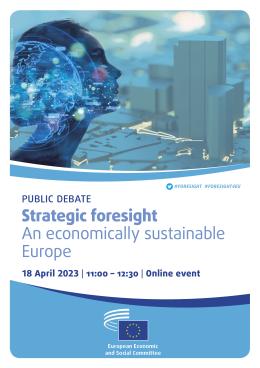
With this debate, the ECO section is providing ex-ante input to the European Commission, in preparation for the upcoming 2023 strategic foresight cycle that wants to shed light on the strategic decisions needed to ensure a socially and economically sustainable Europe with a stronger role in the world in the coming decades.
One of the main conclusions of the 8th Cohesion Report is that although cohesion and convergence among regions in the European Union has improved, there are still remaining gaps especially in less developed regions related with their territorial characteristics. EU islands, mountain areas and sparsely populated areas still face many challenges on their growth and income and disparities exist.
In these regions, there are still a lot of gaps in terms of employment and investment, social exclusion is evident and gender disparities have not diminished.
Download format:
Download — Stellungnahme des Ausschusses: Main challenges faced by EU islands, and mountainous and sparsely populated areas