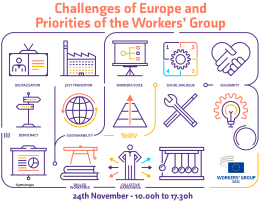
The Workers' Group is organising an extraordinary meeting on the current challenges for Europe and the priorities of the Workers' Group in this framework.
In an exploratory opinion requested by the German Presidency of the Council, the EESC sets out "diversity management" measures for ensuring that migrants and ethnic minorities are better included in and integrated into the workplace and society.
This study analyses European Union (EU) policy through the lens of intergenerational poverty (IGP), shifting attention from poverty as a static condition to the long-term persistence and transmission of disadvantage across generations.
Europe is facing a pivotal moment. Social and economic inequalities, rapid technological change, anti-democratic forces and geopolitical instability are straining the foundations of the European project.
With democracy and civic space under mounting pressure, civil society organisations, human rights defenders and free media face growing constraints - from restrictive laws and disinformation campaigns to underfunding and public distrust. Deepening polarisation and eroding trust in institutions further undermine Europe’s democratic model.
This paper examines the labour-market implications of artificial intelligence (AI) focusing on employment, distribution, and economic governance within the European Union. It presents the reader with the complicated literature around automation technologies, and their impacts on labour. Arguing that AI represents a qualitatively new phase of automation but continues to demonstrate similar trends to previous waves, only this time targeting routine cognitive and white-collar jobs.
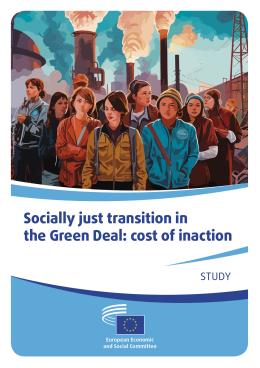
The study assesses how a prospective EU Just Transition Directive (JTD) could shape the social and employment outcomes of the European Green Deal. Drawing on literature review, stake-holder interviews, foresight-based PESTEL scenario building and partial-equilibrium projections, it develops business-as-usual, as well as weak and strong JTD scenarios to 2045. The scenarios focus on seven Member States representing diverse welfare and production regimes.
This study examines how social partners and civil society organisations in six Member States — Italy, Austria, Hungary, Poland, Portugal and Sweden — view the effectiveness of current policies in raising employment levels and increasing adult participation in training. It also puts forward recommendations for improving policy outcomes.
This report, prepared for the EESC Workers' Group, analyses the question of defence in the European Union within its current state of play and its insertion into the broader debate of security
This study, commissioned by the European Economic and Social Committee, examines the state of implementation of the European Pillar of Social Rights and its Action Plan in 2024