
European Economic
and Social Committee
European Media Freedom Act – an important cornerstone in defence of media freedoms
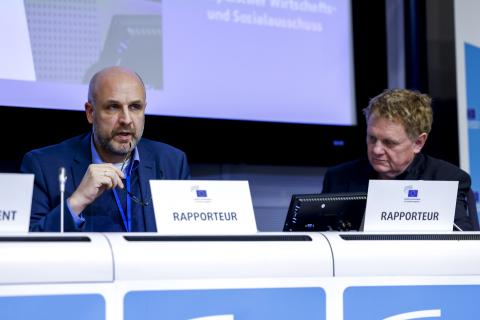
With both external and internal threats to Europe's liberal democracy on the rise, it is becoming more and more important to protect media pluralism and independence
The European Economic and Social Committee (EESC) welcomes the European Commission's initiatives for media freedom, but warns that mere recommendations and a soft-law approach will not be enough to ensure that the media in Europe remain free and independent from political, commercial and other types of interference.
In its opinion on the European Media Freedom Act (EMFA) – Proposal for a Regulation and Recommendation – a new set of rules proposed by the Commission to protect media pluralism and independence in the EU, the EESC pointed out that media freedom and diversity were fundamental for the rule of law and liberal democracy.
External influences attempting to manipulate public debates in Europe have been on the rise, in particular in the context of recent geopolitical upheavals. This makes it even more urgent to strengthen media freedom and pluralism, as they contribute a great deal to making the EU more resilient in the face of such threats.
Media freedom is in danger. Authoritarianism has been on the rise, also in Europe. The fourth estate is a firewall against this illiberal onslaught. Therefore, it is of utmost importance to strengthen media freedom. The EESC supports the Commission and the European legislators in defending media diversity. Neither governments nor private interests must control the media landscape. Public media which is not fully independent becomes a propaganda instrument. Media moguls with information monopolies pave the way for anti-democratic forces. The European Media Freedom Act is therefore an important and very timely initiative
, said the rapporteur for the EESC opinion, Christian Moos.
We are observing more and more political and economic influence in several EU countries, both in public and in private media with close links to power, which is incompatible with the role of media as the fourth estate,
said co-rapporteur of the opinion, Tomasz Andrzej Wróblewski.
In the opinion, the EESC gave its full support to the proposals that strengthen and defend the editorial independence of both journalists and publishers. It also placed particular focus on the independence and impartiality of public media, pointing to the need for adequate and stable financial resources as the means to achieve this.
Public media only make sense if they are impartial and entirely independent of political influence, otherwise public financing can lead to all sorts of abuses and government manipulation. Any media financing project should be based on very transparent rules and guarantees of political independence for journalists
, states the opinion.
Another alarming problem identified by the opinion is the threat to media pluralism resulting from market concentration. The EESC therefore welcomed the proposed measures to increase the transparency of market concentration. Although concentration in the media market does not necessarily have a negative effect on media freedom and diversity, which can help smaller media outlets to survive, information monopolies certainly constitute a threat. Taking action is in particular warranted against media capture by media moguls and oligarchs who often have close links with leading politicians in a country, or even governments of third countries. In cases where media market concentration is not addressed by national regulators, EU anti-concentration law should be used.
Media ownership should by all means be transparent and requirements for its transparency binding, although this should not lead to an excessive administrative burden for small media outlets. The EESC also welcomed the EMFA's binding transparency requirements with regard to the allocation of State advertising.
It expressed concern about the lack of independence of some national regulatory bodies and recommended defining a framework that would remedy this. Those national authorities or bodies that are not fully independent should not participate in the proposed European Board for Media Services, which should promote the consistent application of the EU media law framework. The independence of these bodies should be assessed by the criteria to be defined in the regulation.
According to the EESC, the Board itself should also be fully independent, including from the European Commission, which is currently not the case. If this is not achieved, the Board may not exercise any supervisory or regulatory tasks, the EESC argued in the opinion.
The EESC underlined the importance of the fact that, being a regulation, the European Media Freedom Act will have direct effect. At the same time, it questioned whether the soft-law approach of the recommendation was an effective way of achieving the EMFA's objectives.
Mere recommendations are not enough to guarantee media freedom and diversity in the Member States. Free and independent media must be binding criteria for the rule of law report and for triggering the mechanism in Member States where governments violate media freedoms and independence
, stressed Mr Moos.
The opinion complements previous work by the EESC in the area of media freedom, including its own initiative opinion on "Securing media freedom and diversity in Europe" and its opinion on strategic litigation against public participation (SLAPP).
Work organisation
Recommended for you
EWSA: Die EU muss die soziale Nachhaltigkeit stärker ins Blickfeld rücken
News
Der Europäische Wirtschafts- und Sozialausschuss (EWSA) fordert die Europäische Kommission auf, einen längst überfälligen Bericht zu veröffentlichen und die Ausweitung des Anwendungsbereichs der EU…
Ko-Kreation von Dienstleistungen von allgemeinem Interesse im Bereich Gesundheit als Beitrag zur Stärkung der partizipativen Demokratie in der EU
News
Bei dieser vom Europäischen Wirtschafts- und Sozialausschuss (EWSA) und der Universität Debrecen organisierten Veranstaltung wurde hervorgehoben, wie wichtig die Ko-Kreation von Dienstleistungen von…
Zur Bekämpfung des Klimawandels werden mehr öffentliche Investitionen in die Energieinfrastruktur in der EU gebraucht
News
In einer auf der Plenartagung im September verabschiedeten Stellungnahme erläutert der Europäische Wirtschafts- und Sozialausschuss (EWSA), dass zur Verwirklichung der Energiewende und der Klimaziele…
Energie – EWSA warnt vor neuen Abhängigkeiten
News
Der Europäische Wirtschafts- und Sozialausschuss (EWSA) bezieht in einer auf seiner September-Plenartagung verabschiedeten Stellungnahme klar Stellung zum Thema Energie: Der Vorschlag der Kommission…
Der EU-US-Handels- und Technologierat muss die Dynamik nutzen, um ein Wegweiser für Handel, Technologie und Innovation zu werden
News
Auf seiner Juli-Plenartagung zeigte sich der Europäische Wirtschafts- und Sozialausschuss (EWSA) optimistisch, dass der neue Handels- und Technologierat (TTC) ein innovatives Instrument für die EU…