Lessons learned and a new Inflation Governance Framework
Event type
Conference
Location
room VMA 22, Van Maerlant 2
Brussels
Belgium
On Wednesday, 3 September 2025, from 14:00 – 17:30 (CET), the European Economic and Social Committee (EESC) will host an event organised by the Foundation for European Progressive Studies, in cooperation with Fondazione Pietro Nenni and tasc, discussing lessons learned from the recent inflation episode and the new inflation governance framework that needs to be developed to prevent or mitigate the supply side inflation shocks in the future.
In a context such as the one that Europe is experiencing, characterised by multiple crises, it is appropriate to promote a reflection on European public goods and on fundamental political priorities capable of ensuring the sustainable growth of the EU and the well-being of its citizens. This reflection gets ever more important in view of the upcoming negotiations on the next European Multiannual Financial Framework for the period post 2027.
On 11 February, the European Commission published its 2025 work programme. Several initiatives in the work programme – initiatives to enhance competitiveness through the promotion of reforms and investments, both private and public, the new the Savings and Investment Union, as well as the next Multiannual Financial Framework, just to name a few – fall in the remit of the Section for Economic and Monetary Union and Economic and Social Cohesion (ECO) of the European Economic and Social Committee (EESC). We organise this debate to discuss with representatives of the Commission and the members of the EESC the conditions and actions needed for the EU and its Member States to successfully implement what is outlined in the Commission and achieve the shared goals of the Union.
Strengthening the European Semester to support reforms and investment in Member States in order to enhance competitive sustainability and growth
Location
Online event
Brussels
Belgium
With the revision of the EU economic governance framework, which is built around the European Semester, the latter has also been adapted and strengthened in its coordination of the economic, budgetary, employment and social policies of the Member States. From 2024, national medium-term fiscal structural plans will replace the former national reform programmes and stability/convergence programmes. These plans, which have to be submitted by 20 September, should detail the reforms and investment that countries intend to adopt in order to strengthen sustainable growth, and should address the main challenges (digital, green and social) identified in the context of the European Semester (and in particular the country-specific recommendations (CSRs). The EESC sees a number of opportunities in this review and calls in particular for greater transparency in the Semester, for appropriate involvement of organised civil society and for proper monitoring of the implementation of medium-term fiscal structural plans.
Public debate with Fabian Zuleeg, Chief Executive and Chief Economist, European Policy Centre (EPC)
Event type
Debate
Location
Online event
Belgium
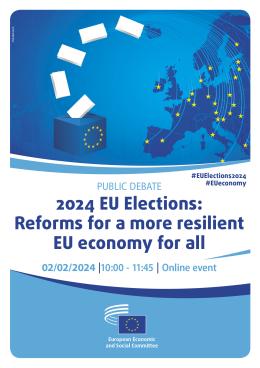
Public debate on Reforms for a more resilient economy for all: the new EU legislature with Fabian Zuleeg, Chief Executive and Chief Economist, European Policy Centre (EPC)
Lessons learned from the first years of the implementation of the programming period 2021-2027
Event type
Debate
Location
Online event
Belgium
Public debate on 9th Cohesion report: Lessons learned from the first years of the implementation of the programming period 2021-2027, in the framework of the ECO section meeting.